
Contemporary choreography is not just for contemporary dance.
The principles of contemporary choreography
If you are a commercial, hip hop, ballroom, folk, or even contemporary dance artist, this article is for you.
In the next few lines, you’ll discover how, no matter which discipline you belong to, understanding and applying the fundamental aspects of contemporary choreography can help you avoid being left behind, outdated, uncool, or simply becoming a bad choreographer. You’ll also see how choreographing can become one of the most fulfilling aspects of your dance career, both personally and professionally. Shall we?
The key is in the real meaning of each word. Definitions from the Cambridge Dictionary:
- “Contemporary”: existing or happening now
- “Choreography”: the skill of combining movements into dances to be performed
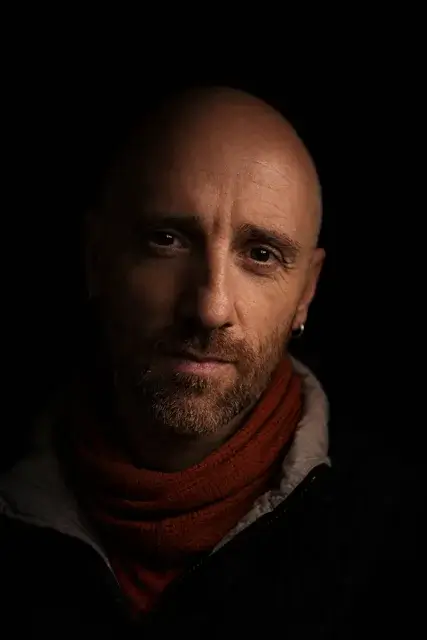
Jorge Crecis is a Spanish award-winning choreographer, dancer, educator, and researcher.
With a background in Sport Sciences and a Master’s in Elite Athletes Coaching, he trained in contemporary dance at the Royal Conservatory of Madrid. He served as a full-time lecturer at London Contemporary Dance School (The Place) from 2008 to 2012 and has taught and coached internationally, including at Beijing Dance Academy and for companies such as Akram Khan, DV8, and Rambert.
His dynamic, athletic choreographic works fuse sports energy with contemporary dance and have been presented at New York City Center, Sadler’s Wells, Royal Opera House, and Beijing’s 798 District. Notable commissions include Acosta Danza (Best Dance Work, Cuba 2017), Birmingham Royal Ballet, Scottish Dance Theatre, and AXIS Dance Company.
In 2014, he co-founded the Pan-Arab company min tala. He holds a PhD from Goldsmiths University of London and created the Towards Vivencia training methodology. He is the author of Designing Presence and currently lectures in Choreography at the Institute of the Arts Barcelona.
What is Contemporary Choreography?
Therefore contemporary choreography is the practice of composing with what is happening now: the training methods, socio-political contexts and questions of the present moment, whether the work is framed as modern, commercial, jazz or the so-called contemporary dance style. And if we are going down the etymological route, the actual word choreography comes from the Greek choreia (dance) and graphien (to write). Historically, it meant “writing steps”.
Today, in a broader and more useful sense, we can think of contemporary choreography as the art of organising human experience in time and space: directing dancers as they devise material, collaborating with costume, sound, scenography and light, and often making the final decisions about what unfolds in front of the audience.
That means every choice made in the studio – from how we greet our dancers to how we combine a series of steps – is already choreography.
In this article we want to share the principles that sit behind the practice of many well-known contemporary choreographers; how I personally choreograph; and how I teach choreography. Here, I am not offering rules to obey, but lenses and good practices that you can use to look at your own work and analyse other’s people choreographies and creative processes.
Choreography begins with people, not material
The first principle is simple: There is no dance without dancers.
Before a work is performed, it exists as an idea. After the performance, it survives as a memory or a recording. Dance itself only happens when someone is dancing.
So, before thinking about style, theme or music, I suggest focusing on the people in the room.
- Who are they?
- How are we going to interact with one another today?
- How do they arrive – tired, excited, anxious, bored?
- What do they need in order to work, feel safe and take risks?
As choreographers we are working with human material: stories, memories, nervous systems and bodies. If we cannot listen, if we cannot name emotions, if we cannot be present with other people, our work will always be limited, no matter how “interesting” the movement is.
Here are three ways to reduce the risk of harmful interactions and misunderstandings.
A) Code of conduct
Choreography can no longer be understood only as a system for creating steps. It is also a framework for ethical relationship: how we share space, power and vulnerability between diverse bodies in changing contexts.
In this sense, choreography becomes ethical technology. It designs relationships, distributes agency and asks us to rethink authorship, consent and responsibility in every compositional decision. When people feel safe, seen and respected, they are more willing to take creative risks. The piece gets better.
B) Vulnerability
Here are three ways to reduce the risk of harmful interactions and misunderstandings.
Vulnerability is often confused with weakness. In creative work, vulnerability is not to be weak; it is to be available.
As choreographers, we ask dancers to share their bodies, their time and, very often, their personal stories. This deserves the same level of care we expect from a good doctor, therapist or teacher.
We can model vulnerability by:
- being clear about our own limits and questions
- normalising “I don’t know yet, let’s try”
- allowing dancers to say no, to opt out of tasks, or to adjust them
- acknowledging when something feels too much, too fast or not right
When availability is mutual – dancers are open, and we are open to adjusting our process – the studio becomes a place where both art and people can grow.
C) Each day is a new one.
Before diving into material, it takes very little time to do a simple check-in round. For example:
- “How are you arriving today?”
- “One word for your inner weather right now?”
Give each person in the room a brief moment to feel seen, answer and let others’ answers inform how rehearsal begins.
This is not small talk and not a waste of time. It is already choreography: it shapes the emotional architecture of the rehearsal and is an investment in the quality of the work that is about to happen.
Start simple… many simples ideas make a sophisticated one
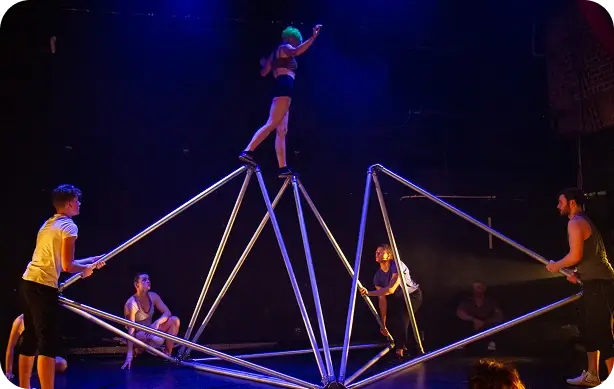
Many emerging choreographers feel they need a “big idea” before they can start. If you already have one, great. If not, and you still feel the urge or need to create, you can always begin from simple choreographic triggers and develop depth from there.
A starting point can be almost anything:
- a soundscape – rain, traffic, breath, the buzzing of neon lights
- a social or political situation that moves you
- a biomechanical question, like “What happens if we choreograph from the shoulder blades?”
- a texture or image – honey, sandpaper, smoke, a crowded metro carriage
- anything: the smell of your grandmother’s kitchen, a broken elevator, a video game, a migraine, an overheard sentence on the bus
On their own, these starting points might feel random or superficial. Choreography is precisely the craft of transforming something apparently simple into something layered, sophisticated and meaningful.
The key is to treat your starting points as springboards, not prisons. You use them to jump into the unknown, not to lock yourself into literal illustration.
If your starting point is “water”, you do not need to show waves and swimming. You might work with transparency, weight, resistance or the feeling of being submerged.
You can even choose a stimulus at random and give dancers a short improvisation task based on it, then build your phrase material only from what genuinely surprises you in their responses. Once the process “pops”, it often does not stop.
Quantity over quality: research first, polishing later
is a quote attributed to Pablo Picasso and a very useful one for choreographers.
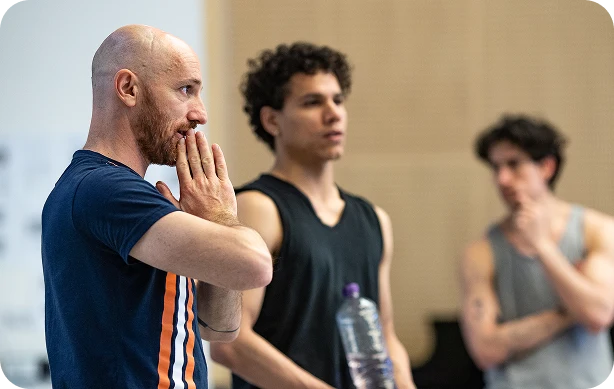
A common trap is trying to make the final piece too early, or wanting to choreograph the perfect eight-count from the beginning. This usually leads to frustration or very safe choices.
It helps to distinguish between research and composition:
- Research is when you explore, test, fail and generate material that might or might not be used later.
- Composing is when you select, structure and refine.
Both are necessary, but not usually at the same time.
In the research phase, our job is to generate ingredients for the dish we will cook later. Set tasks, play with chance, create a lot of material without judging it. When you have “too much”, you move into composition and start making decisions:
- What stays?
- What goes?
- What needs to be clearer?
- What needs to be wilder?
By separating these phases, we protect ourselves and our dancers from perfectionism and keep curiosity alive.
Quantum vs Classical: the physics of choreography
Choreography offers many tools, but three appear again and again: time, space and intention.
A) Space: drawing architectures
Imagine the stage as a blank page. Where do you place your dancers? Are they close together or far apart? Do they move north–south, diagonally, in circles, in apparent chaos?
Spatial composition is not decoration. It guides the audience’s attention and shapes the emotional temperature of the piece.
We can create patterns that are aesthetically pleasing or disturbing, narrative or abstract, like an art installation built from human bodies. Three dancers in a tight clump downstage feel radically different from three dancers scattered in silence across the whole space.
B) Time: rhythm, duration and stillness
Time is not just tempo. It includes duration, repetition, silence and timing between events.
- How long do we stay in an image before it changes?
- What happens if we repeat a phrase until it becomes uncomfortable?
- How does a sudden stop after frenetic movement affect the audience’s nervous system?
By stretching, compressing and disrupting time, we can build suspense, relief, humour, boredom, trance or clarity.
C) Intention: from marking to histrionic
Intention is how much effort, detail and presence dancers bring to the material. There is a huge difference between marking, executing and performing.
Sometimes we want minimal effort, as if the dancer is almost not there. Sometimes we want exaggeration, almost caricature, way “over the top”. All of these are valid, as long as they are chosen.
If all the material sits at the same intensity, it should be a conscious choice. If we move between whisper and scream, it should also be a conscious choice. Intention is the invisible script that tells the audience how to read what they see.
Choreography as training consciousness
Consciousness can and should be trained through the practice of dance. Consciousness is a complex concept, but for our purposes, we can define it as “what it is like to be”: the felt texture of existing in a body, in a moment, in relation to others. It is difficult to study and yet it is the most important thing we can study, because every form of ethics, politics, science, love and meaning begins in conscious experience.
Traditional dance training has focused mainly on the mechanical body: turnout, lines, jumps, turns. But whenever we train the body, we also shape the inner self that perceives, decides and feels – we are training consciousness, whether we acknowledge it or not. Without care, that impact can be confusing or harmful. With intention, it becomes one of the most powerful forms of education a person will ever receive.
Choreography is where this becomes very tangible. Every decision about timing, spatial relationships, touch, gaze or proximity invites dancers to notice what they feel, what they imagine and how they relate to others. A rehearsal process is not only a space to build material; it is a laboratory where perception, attention and values are constantly being rehearsed as well.
If we take consciousness seriously, choreographing stops being only a way to produce a piece for the stage. It becomes a way to develop human beings who can meet a complex world with presence, responsibility and imagination – and dance becomes one of our most precise crafts for rehearsing that way of being together.
Discipline, community and the long game
Motivation comes and goes. Discipline is more reliable.
Choreographers, dancers, doctors, lawyers – everyone sometimes lacks inspiration. Some days you will enter the studio with no ideas, no energy and a long to-do list. This is normal.
On those days, it can help to recommit to your commitment. You do not need to love every rehearsal. You need to show up, be honest about where you are, and work with what is available.
We also do not believe that friends and family are always enough as a professional support system. We need mentors, peers and communities who challenge us and hold us accountable. Choreography is not a solo sport. Your future collaborators and colleagues might be sitting next to you in class right now.
A simple framework for your next piece
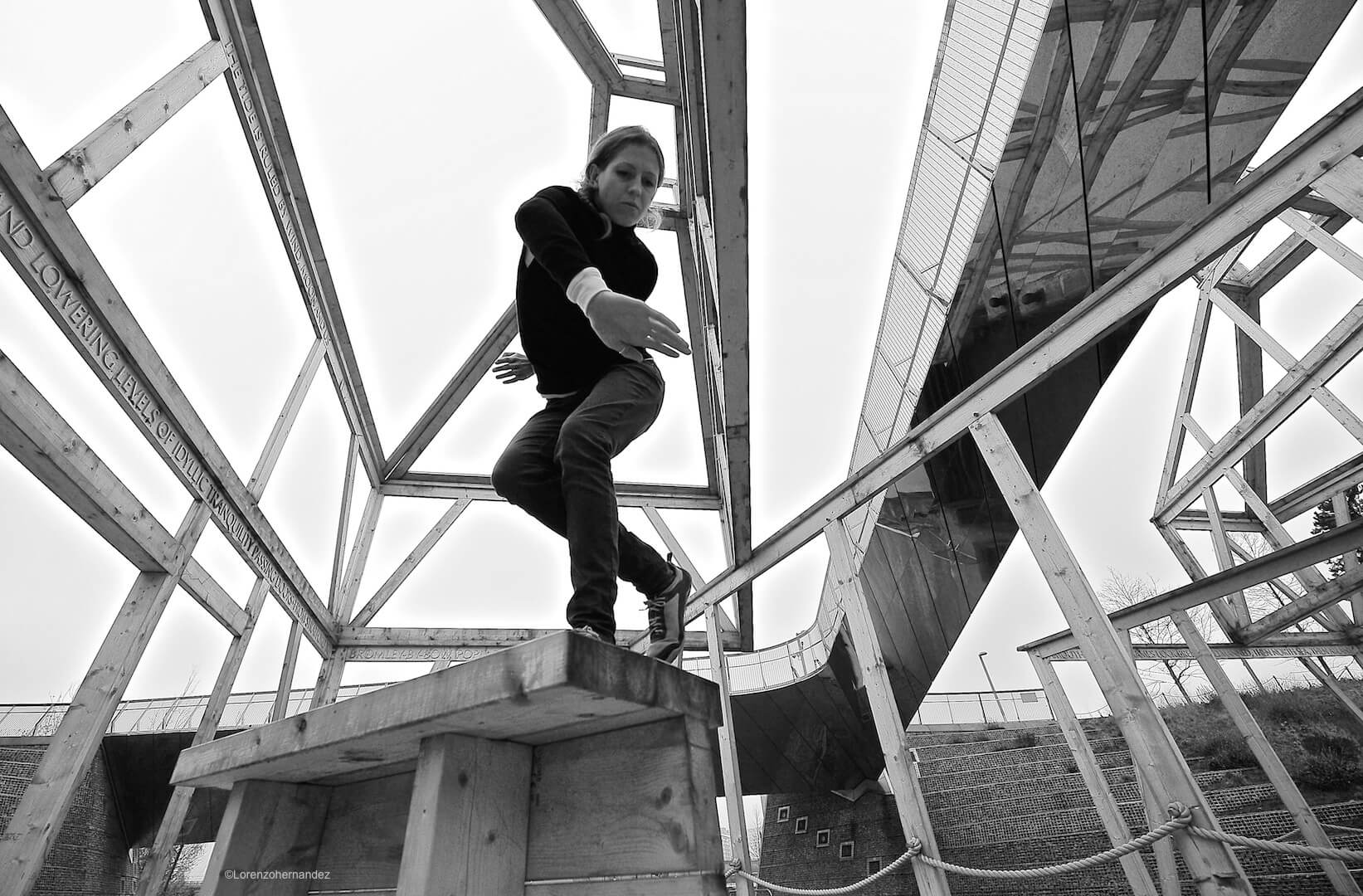
These principles can feel abstract, so here is a framework you can test in your next creation period:
1. People first.
Begin with a check-in and, if possible, co-create a basic ethical code for the process.
2. Choose a starting point.
Pick one concrete trigger and generate material through research tasks.
3. Craft with space, time and intensity.
Take the material you like and sculpt it using spatial composition, timings and different levels of intention.
4. Reflect on consciousness.
At the end of each rehearsal, ask what has shifted in the dancers’ experience of themselves and of the piece.
5. Stay disciplined and playful.
Show up even when you do not feel motivated, and keep humour and curiosity in the room.
You will not get it “perfect”, and you are not supposed to. Choreography is a lifelong practice of paying attention, making choices and refining your craft.
Related Reading:
→ Emotion in Movement, Space – Time for Acting
The future choreographer
Dance is constantly changing, and so are its principles. What seems to remain stable is the idea that choreography can be an act of service.
- We serve the dancers by creating spaces where they can expand their abilities, imagination and sense of self.
- We serve the audience by offering experiences that might move, disturb, comfort or challenge them.
- And we serve ourselves by using choreography as a way to understand “what it is like to be” – to be in this body, in this moment, with these people, on this earth.
If you treat your choreographic practice as a craft, as an ethical responsibility and as a way to train consciousness, you are already contributing to the future of dance.
The rest will come with time, repetition and the courage to keep going when things feel uncertain. That, too, is a principle of choreography: stepping into the unknown and trusting that, together with others, you will find the next movement.
Frequently Asked Questions About the Choreography Process
Begin with people, not material. Focus first on creating a safe, vulnerable space with your dancers. Start with simple ideas and generate quantity before worrying about quality. Use the framework in this guide: define space, explore time, and clarify intention.
Embrace “quantity over quality” – research and generate many movement options without judgment. Treat each day as a new one. Remember that sophisticated choreography emerges from many simple ideas layered together. The physics-based approach (space, time, intention) often unlocks fresh material.
Absolutely. This human-first method is especially powerful for beginners because it removes pressure to be perfect immediately and builds confidence through vulnerability and community.
Choreography is ultimately training consciousness. By working deeply with space, time, and intention, you develop greater awareness of your body, your dancers, and the emotional world you’re creating.
Essential. Great work happens over the long game. A supportive community and consistent discipline turn raw ideas into polished, meaningful pieces.
Layer many simple ideas. Shift from marking to full histrionic intention. Draw architectures in space and play with rhythm and stillness. Let the process evolve organically rather than forcing complexity too early.
Consider structured programs that combine rigorous technique with creative exploration.
Conclusion
Choreography is a lifelong journey that begins and ends with people. By embracing vulnerability, starting simple, valuing quantity in your research, and understanding the quantum interplay of space, time, and intention, you can create work that is both deeply human and artistically sophisticated. Whether you are an emerging choreographer or a seasoned creator, remember that discipline, community, and daily renewal are your greatest allies in the long game of artistic growth.
Keep moving, keep creating, and trust the process – your next piece is waiting to be born.