
What is Movement in Acting Technique?
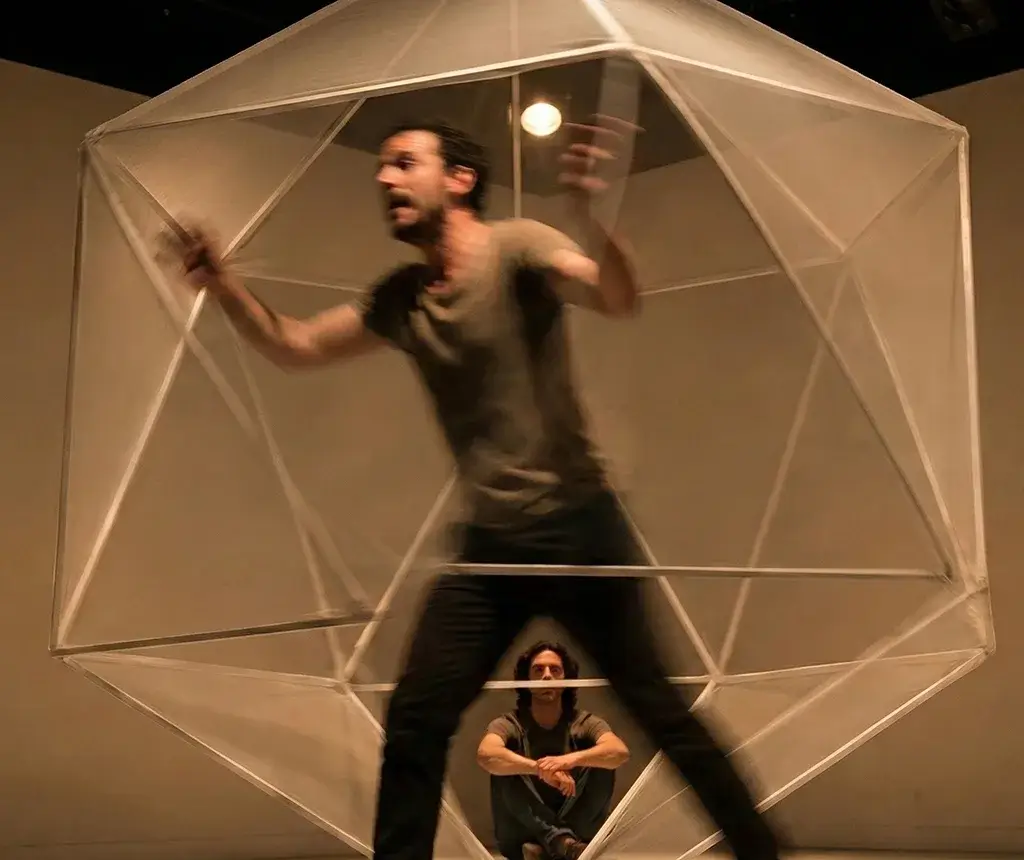
Movement training for actors focuses on developing physical awareness of the body itself, of the surrounding space, and of the expressive potential of movement within that space. An actor does not exist in isolation: they are always situated within a spatial environment that shapes how they move, act, and are perceived.
Rudolf Laban Methods
Space is constantly present around us. As Rudolf Laban demonstrated through his movement analysis and method, understanding how space functions allows the actor to express themselves in a more organic, articulate, and complex way. Laban observed that space influences how we move in everyday life and that this influence is not merely physical but also emotional. The way we approach, avoid, expand into, or retreat from space reflects inner states and intentions.

Rudolf Laban (1879–1958)
was a visionary figure in the development of modern movement practices. A choreographer, teacher, and researcher, he dedicated his life to understanding how humans move and express meaning through the body. Laban created innovative frameworks – most notably what later became known as Laban Movement Analysis – to study movement in relation to space, energy, rhythm, and intention. His work transformed dance training and choreography and continues to influence disciplines such as theater, somatic education, movement therapy, and performance studies worldwide.
“Existence is movement. Action is movement. Existence is defined by the rhythm of forces in natural balance.”
Similarly, when an actor moves through space in an organised, conscious, and meaningful way, that movement produces a specific emotional resonance for the audience. Spatial choices, direction, level, rhythm, and dynamics, become tools of expression, transforming movement into a carrier of meaning and emotion.
Why focusing on the “Emotional”?
Language itself reveals the intimate relationship between emotion and movement. When we experience something deeply affecting, we say, “I am moved.” This expression recognises that there is space not only around us but also within us and that this inner space can be set into motion. That motion is, in essence, emotion.
From this perspective, emotion is not something abstract or purely psychological; it is embodied. It manifests through shifts in posture, weight, rhythm, tension, and spatial orientation. Movement does not simply illustrate emotion, it is emotion in physical form.
This idea is central to Laban-based movement theory. One of Laban’s closest collaborators and key transmitters of his work, Jean Newlove, emphasised that human movement reflects an ongoing dialogue between the individual and their environment. Emotional states emerge from how the body adapts, responds, and relates to space, effort, and intention. For actors, this understanding allows emotion to arise organically from physical action rather than being imposed artificially.

Jean Newlove (1924–2012)
Was a British movement specialist, educator, and writer best known for her significant contribution to the development and dissemination of Laban Movement Analysis. Trained by Rudolf Laban and later collaborating with Irmgard Bartenieff, Newlove played a key role in applying Laban’s movement principles beyond dance, particularly in education, therapy, and professional training.
She co-authored influential texts such as “Laban for All”, helping to make complex movement concepts accessible to a wide audience. Newlove’s work emphasized awareness, expressiveness, and the practical use of movement analysis in everyday life, leaving a lasting impact on movement studies, somatic practices, and interdisciplinary education.
“Movement is our first language.”
The space where we move, moves with us.
Proprioceptive Connection: The Intuitive Power of Movement in Theatrical (acting) Performance.
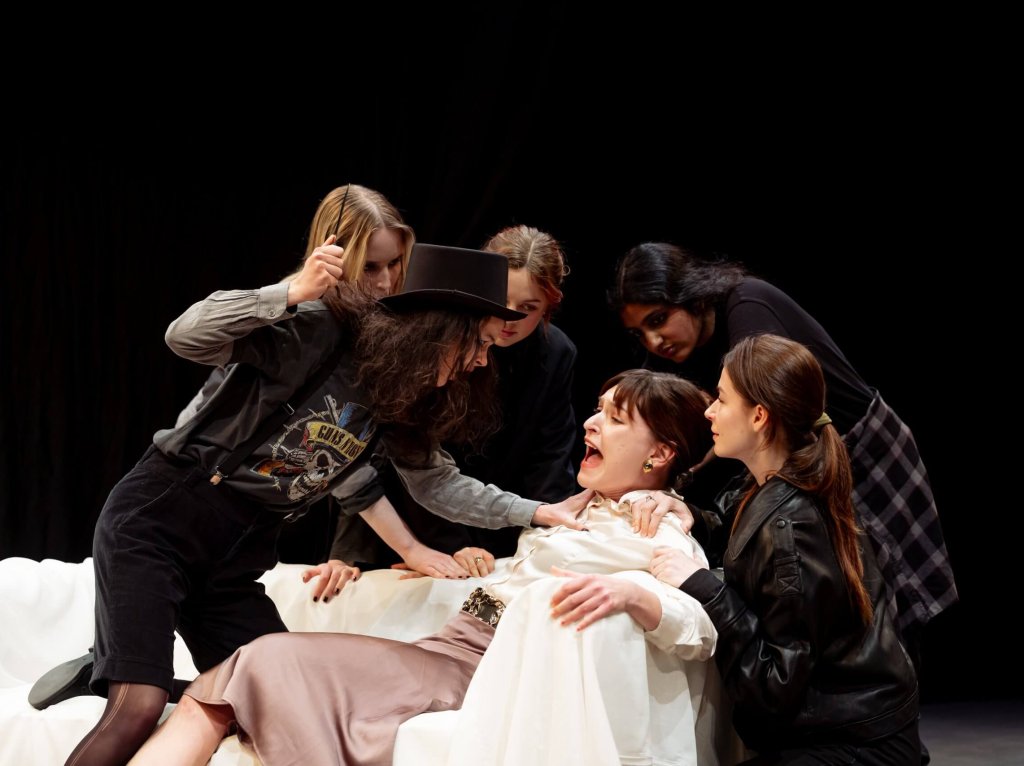
Actors are the central point of a theatrical representation that unfolds in three-dimensional space and is therefore always a visual experience from the audience’s point of view. Every gesture, step, stillness, and spatial relationship contributes to how the character’s life is perceived.
The audience receives the emotional and narrative content of a performance largely through the actors’ movements and their actions in space. This reception is not purely intellectual. Much of the audience’s response is spontaneous and intuitive, because it engages the senses directly.
One of these senses is proprioception, the embodied perception of movement, balance, and spatial orientation. Even while seated, spectators internally register the dynamics of movement they observe. They feel expansion, contraction, tension, flow, and direction. As a result, the actor’s movement in space creates an empathetic physical response, drawing the audience into the emotional world of the performance.
The Function of Movement in Acting
Movement plays a fundamental role in shaping both the external journey of the character through space and the internal structure of the character’s physical identity. It helps create the “architecture” of the performance, how the character enters, occupies, and transforms space over time, and also the personal physical characteristics of the character.
These elements allow the actor to inhabit the character fully and to live the play coherently from beginning to end. The emotional journey of the character is mirrored by a corresponding physical journey, expressed through movement quality, spatial patterns, and physical actions.
To develop this work, several movement traditions are particularly valuable. These include Rudolf Laban’s basic principles of space articulation and definitions of physical efforts; ensemble and neutral work rooted in Jacques Copeau’s tradition; the fundamental elements of Jacques Lecoq’s improvisation method connected to the work on levels of tensions; exercises and repertoire pieces from Étienne Decroux’s Corporeal Mime technique; and contemporary practices developed by companies such as Complicite.

Jacques Copeau (1879–1949)
Visionary French theatre director & founder of Théâtre du Vieux-Colombier (1913). He revolutionized modern stage by rejecting commercialism, embracing bare staging, ensemble spirit, & innovative actor training with neutral masks, improvisation & physicality – birthing a legacy in physical & poetic theatre that shaped Lecoq, Barrault, Brook & beyond.
Key elements of Copeau’s tradition include:
- Bare or simplified staging
- Actor-centered training
- Ensemble ethos
- Repertoire balance
“Under a mask, the face disappears and we see the body. The body becomes a face.”
Emotional memory and experience in acting
Memory plays a fundamental role in an actor’s work not only on a psychological level, but also and perhaps more importantly on a physical one. An actor is able to embody emotions more truthfully when they can connect them to personal memories that are also physical memories.
Every lived experience leaves a trace in the body. In this sense, the body carries the score of our emotional and experiential life: patterns of tension and release, habitual rhythms, postural tendencies, and spatial behaviours shaped over time. These embodied memories are not static; they are continuously activated and reactivated through movement, displacement in space, and interaction with others.
When an actor moves, changes direction, shifts weight, or enters into a physical relationship with another performer, this corporeal memory is awakened. Emotion emerges not as an abstract idea to be represented, but as a lived, embodied state arising from action. Movement thus becomes a gateway to emotional truth rather than a decorative layer applied on top of it.
The same process extends to the audience. Spectators are able to recognise, interpret, and be affected by dramatic action more deeply when the actor’s physicality is coherent and precise in terms of texture, form, effort, rhythm, and dynamic quality. When movement is emotionally grounded and physically truthful, the audience receives its meaning intuitively, through sensory and kinaesthetic empathy, reinforcing the emotional impact of the performance.

Space / Movement - Time
Space on stage also generates time; in this sense, we can say that space is time. In theatrical performance, the coexistence of multiple spaces, or the succession of different spaces arranged in a chronological order, becomes a construction of time. This is a time that would otherwise remain anchored to the “here and now” of the present moment.
This anchor is released because the “here” -that is, space- can change. When space changes, not only its appearance is transformed, but also the way the character moves within it. Through this transformation of spatial conditions and movement qualities, theatre creates the fiction of a different time – one that is imagined, constructed, and yet fully accepted and experienced by the audience within their continuous present.
Conventional space-time does not cease to exist; rather, another layer of space–time is created on stage alongside it. This theatrical space-time has its own form and structure, composed of movements and gestures in space, as well as rhythms such as repetition, acceleration, deceleration, and suspension. These elements reshape the audience’s perception of duration and sequence, giving time new dimensions beyond linear chronology.
Through movement, rhythm, and spatial organisation, actors do not simply represent time – they produce it. Time becomes a physical, visible, and experiential phenomenon, embodied by the performer and perceived kinaesthetically by the spectator.
Movement is therefore crucial not only for actors but also for directors, operating on multiple levels. It contributes to the creation of clear and coherent characters, shapes the character’s journey through the stage and the successive moments of the play, and enables both actors and directors to conceive dramaturgy spatially, thereby defining its temporal structure.