1. Introduction: Looking Beyond Entertainment
In a cultural landscape overwhelmingly dictated by the relentless demands of powerful entertainment, a profound shift is taking place: artists are increasingly refusing to be passive interpreters, choosing instead to take full ownership of their creative output. We see this at the highest levels of the industry, where A-list film actors are now launching their own independent production companies to bypass traditional studio constraints and champion specific, often overlooked narratives.
For an emerging generation of theatre-makers, a sold-out run and a round of applause are no longer the sole metrics of a meaningful career. By stepping into roles as writer-director-producers, they are seizing the reins to build their own visions from the ground up. In doing so, questions regarding social relevance, cultural access, representation and civic responsibility have become intrinsic to their artistic practice.
What are the communities we are creating for? Who has access to our work? Whose experiences remain absent from our stages? And crucially, what happens after the performance ends?
As a Romanian theatre maker, I have found myself over the last 20 years in a constant state of pivoting in order to maintain relevance. My work has been more into the field of theatre rather than film, gliding from acting to managing independent or subsidised theatre spaces.
In all positions I have found the principle of Agility essential for when seeking relevancy in the performative world.
- Romania (Eastern Europe, for those wondering) provides a compelling landscape for examining how independent artists and grassroots organisations have pioneered distinct responses to the gaps in cultural participation. I will use three examples that I hold close that can illustrate this:
- Vanner Collective – producing theatre company – leverages touring and educational theatre to reach diverse communities;
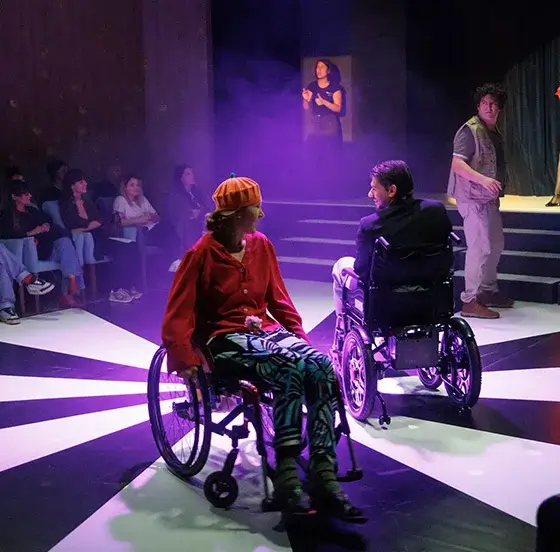
- the production of Supernormals (created at Teatrelli, Bucharest, 2025) that tackles disability through the politics of representation and accessibility;
- and Ideo Ideis Festival that fosters long-term cultural education and community engagement.
Together, they demonstrate a vital truth for the international arts sector: there is no single, monolithic formula for creating social change through theatre, but agility is a key word in order to maintain constant relevancy.

2. Agile in-between Theatre and Social Change
To borrow a concept from the business sector, socially engaged theatre operates on an essentially Agile framework. In traditional theatre (the equivalent of a linear “Waterfall” model), a script is written, rehearsed, and delivered to a passive audience as a finalised product. Socially engaged practice, however, fundamentally challenges the boundary between creator and consumer. It relies on iterative development, continuous feedback loops, and an adaptable approach where communities become active collaborators rather than passive end-users.
Socially engaged theatre thrives when artistic rigour and social dialogue are mutually reinforcing. Just as Agile project management relies on cross-functional teams, theatre-makers must share the rehearsal room with experts from outside the arts: teachers, psychologists, social workers, researchers, local NGOs and so on.
Ultimately, the fundamental question shifts. Instead of dictating a rigid, predetermined plan (“What performance do we want to make?”), the artist adopts a responsive, user-centric mindset: “Who are we making this with, who is it for, and how must we adapt based on what they tell us?”
3. Communities Matter: Bridging the Centre and the Periphery
Romania boasts a historically robust network of publicly funded state theatres. However, cultural capital and funding remain heavily concentrated in Bucharest and a handful of major regional cities. For a theatre-maker in Spain, also, this dynamic can be recognisable: with a cultural hyper-concentration in Madrid and Barcelona, leaving many provincial and regional towns culturally under-resourced.
In both nations, true cultural participation in the periphery requires a sustained ecosystem – opportunities to meet artists, attend workshops, and integrate into wider networks – which centralised state institutions often fail to provide. Consequently, independent organisations have stepped in to bridge this gap, pioneering models rooted in civic engagement and cultural mobility.
The parallels between the two independent ecosystems are strong. In Romania, grassroots spaces like Bucharest’s REPLIKA Educational Centre or Cluj-Napoca’s REACTOR have become vital organisms for political theatre, educational initiatives and socially driven projects. They share their exact DNA with Madrid’s Teatro del Barrio, for example. Rather than merely staging plays, these hubs operate outside the bureaucratic state monoliths, functioning as agile incubators for new dramaturgies that challenge the status quo and foster direct, unapologetic community dialogue.
This drive toward decentralisation fundamentally rewrites the social contract between artists and audiences. Ultimately, whether navigating the Romanian provinces or the regions outside Spain’s major metropolitan areas, the underlying friction remains universal:
How can independent cultural organisations forge authentic, lasting relationships with communities stranded on the periphery of major cultural hubs?
4. Model One - the company: Vanner Collective
Prototyping as Social Intervention
For Vanner Collective, the act of touring has evolved far beyond a mere distribution strategy; it has become the bedrock of our artistic methodology. Rather than treating a tour as the final exhibition of a fixed product, we utilise mobility as a form of live, cultural prototyping.
Our operational model intentionally disrupts the traditional theatrical pipeline. A new Vanner production typically launches with previews in Bucharest, but rather than immediately settling into a local run, it embarks on an extensive national tour across provincial cities. Only after navigating the diverse social realities of the country does the production return to the capital to officially enter the current season of a partner theatre.
This methodology is perfectly illustrated by our 2026 autumn production, Liber Volatilium. Built upon a dramatic structure co-created by four female playwrights, the performance tackles the urgent, highly contemporary theme of political leadership. It operates as a sharp political allegory about the human need for belonging and the insidious mechanisms of mass manipulation, all explored through a utopian universe populated by birds. The play poses a vital, uncomfortable question to its audience:
How easily do we fall prey to promising systems of “collective flight” when they are orchestrated by charismatic figures promising a better world?
Taking a complex, politically charged allegory like Liber Volatilium on the road proves that a performance is never truly finalised until it meets its community. During the national tour, representations are never standalone events. They are structurally accompanied by post-show encounters and debates involving local experts, NGO representatives, and community leaders. The direction of these conversations pivots adaptively, depending on the specific socio-political anxieties and themes most relevant to each local town.
Crucially, this touring model generates a profound systemic impact by actively diversifying local repertoires. Through strategic partnerships with provincial state theatres, Vanner Collective has systematically injected a wide spectrum of urgent socio-political themes into cities that often lack access to contemporary independent work. Our portfolio of touring productions illustrates this thematic breadth: we have worked with Duncan Macmillan’s play Every Brilliant Thing to open up fragile, destigmatising conversations about mental health; staged Komorebi (with a text by Romanian playwright Raluca Mănescu) to deconstruct the pressures of toxic masculinity; interrogated censorship and the fragility of freedom of speech through Sam Steiner’s Lemons Lemons Lemons Lemons Lemons; and presented Duncan Macmillan’s Monster as a visceral exploration of empathy and the roots of bullying. More importantly, this continuous exposure to diverse, challenging subjects cultivates a new appetite among audiences. It engages communities that may not yet be accustomed to consuming political art or participating in public debate, gradually shifting their cultural expectations. Through this sustained effort, the local theatre ceases to be perceived merely as a venue for weekend entertainment, transforming instead into a vital, democratic space for civic reflection and social transformation.

5. Model Two - the production: Supernormals
Who Gets to Be Seen on Stage?
If cultural mobility asks who has access to theatre, the politics of representation poses an equally urgent question: who is permitted to be seen on stage?
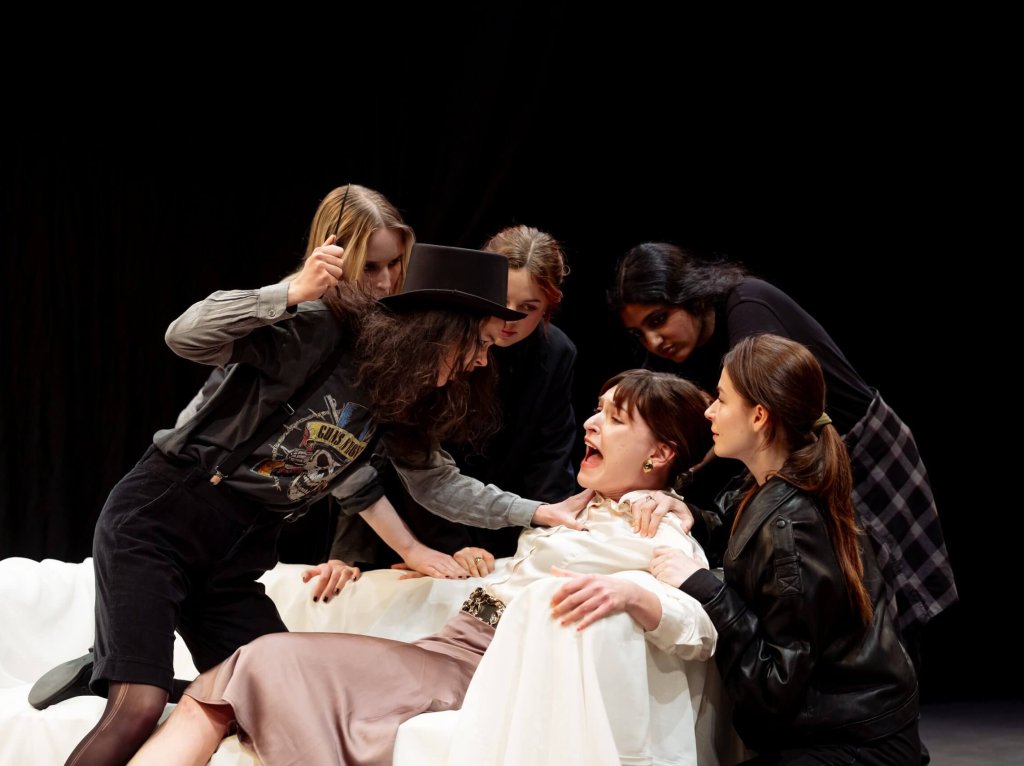
Supernormali, based on the provocative play by Galician playwright Esther F. Carrodeguas and staged by director Mara Oprea at Teatrelli in Bucharest in 2025, confronts disability by illuminating themes routinely scrubbed from mainstream narratives: sexuality, intimacy, bodily autonomy, and the fundamental right to self-determination. In the Bucharest staging, the cast brings together 6 non-disabled actors with 4 performers with disabilities in a 2-hour roller-coaster.
Historically, disability in the performing arts is straitjacketed into two damaging tropes. At the moment, in Romania, disabled individuals are depicted either as tragic victims in need of neurotypical salvation, or as ‘inspirational’ heroes celebrated merely for surviving their daily lives. Both narratives strip the individual of their nuance, reducing their entire humanity to their diagnosis.
Supernormals shatters this binary.
By physically integrating four performers with disabilities alongside six non-disabled actors, the Bucharest staging proves that authentic inclusion is not achieved merely by writing a play “about” a social issue; it is achieved by literally sharing the stage and redistributing power.
The arrival and success of Carrodeguas’s text in Bucharest (2026 Award from British Council in the UNITER Gala) is indicative of a broader, fascinating trend: the growing influence of contemporary Spanish dramaturgy on the Romanian theatrical landscape. Right now, Spanish theatre-makers are exporting some of the most courageous, meticulously researched and unapologetic perspectives in Europe. Writers like Esther are forcefully placing historically taboo subjects – intersectionality, feminism, mothers and the politics of care, and systemic ableism – front and centre. They provide a powerful blueprint for how to tackle profound societal wounds with sharp wit and humour.
Contemporary Romanian playwrights are increasingly pressing these exact same buttons. A new wave of local dramaturgy is emerging, one that actively shifts its gaze away from the repetitive historical traumas of the post-communist transition to confront the uncomfortable truths of today. Romanian writers and independent collectives are now conducting their own immersive research into neurodiversity, systemic sexism, LGBTQ+ representation or class inequality. They are crafting local narratives that demand agency, insisting that marginalised individuals are the authors of their own stories, not just subjects of observation.
Ultimately, this cross-cultural theatrical exchange highlights the lifeblood of socially engaged art. Whether a text originates in Galicia, in Madrid or in Cluj-Napoca or Bucharest, the ultimate goal remains identical: bridging the vast chasm between merely talking about a marginalised community and actively cultivating an ecosystem where their voices, bodies and lived experiences actually govern the artistic process.

6. Model Three - the festival: IDEO IDEIS
Building Communities Instead of Audiences (H3)
A third model shifts the spotlight away from the finished theatrical product, focusing instead on long-term, slow-burn community processes.
The story of Ideo Ideis Festival is, in itself, a testament to grassroots initiative. It was born in 2006, remarkably, by a group of teenagers in Alexandria – a Romanian city historically devoid of a professional theatre, with around 50.000 inhabitants. Over 21 years of existence, it has organically expanded from a local youth theatre festival into a formidable, nationwide platform for cultural education and civic participation. At its core, it utilises mentorship as a powerful form of extracurricular development, offering teenagers across Romania the tools to navigate their formative years.
Crucially, Ideo Ideis perfectly exemplifies the Agile methodology discussed. The ultimate test of a socially engaged initiative is its capacity to pivot, and the festival demonstrated profound organisational agility during the 2020 pandemic. When restrictions made it impossible to gather the selected high school troupes in Alexandria for the annual festival, the organisation refused to simply cancel or move entirely online. Instead, it innovated the “Capsule” model. Rather than demanding that young people migrate to a central hub, Ideo Ideis physically decentralised the festival, deploying professional artists and mentors directly into the 8 distinct local communities where the selected troupes lived.
This agile mindset fundamentally changed the festival’s DNA. It proved that you do not need a central institution to create a cultural phenomenon. Following this same philosophy of decentralisation, Ideo Ideis has increasingly pushed its events out of the traditional, enclosed theatre halls and directly into the heart of the community. By taking over public squares, parks and streets, the festival embeds itself into the daily rhythm of the city, meeting the public on their own turf.
This represents a paradigm shift. The traditional arts sector generally builds an artistic product inside a building and then desperately hunts for an audience. Community-based practice flips this architecture entirely: it begins with the geography, the people, and the pre-existing local relationships, building the art outward from there.

7. The Agile Artist
The model of the passive actor – waiting for a casting call to deliver a rigid, top-down product to a silent audience – is rapidly fading. Emerging professionals must understand that contemporary performative constructions are no longer static entities, but they are living, breathing ecosystems. The relationship with the audience is no longer transactional, but a deeply collaborative one.
To successfully navigate this space, young artists must adopt an entrepreneurial, almost scientific mindset. They must become keen observers, active listeners and agile creators. We can see this Agile philosophy – rooted in observation, live prototyping and continuous feedback loops – perfectly mirrored in the three examples mentioned above:
Vanner Collective utilises iterative prototyping.
By taking a complex production on a national tour before settling it into a capital-city repertoire, they test and adapt the civic conversation in real-time. They observe how different socio-economic demographics interact with the work, allowing the community’s feedback to shape the post-show debates.
Supernormals champions user-centric co-creation.
It dismantles the traditional hierarchy by ensuring that those whose stories are being told – performers with disabilities – are physically sharing the stage and directly steering the performative construction, proving that representation must be built with the community, not just for them.
IDEO IDEIS exemplifies rapid responsiveness to change.
When faced with a systemic crisis, they did not cancel their operations; they pivoted. By decentralising their festival into local “capsules” and moving out of formal venues into public spaces, they adapted their cultural product to meet the immediate needs of their end-users.
Communities will react in ways you never storyboarded. Post-show debates will prove your initial assumptions wrong. The ability to pivot gracefully, adapting the artistic intervention based on real-world observation without compromising aesthetic integrity, is the true hallmark of a socially engaged artist.
These Romanian examples prove that community-engaged theatre is a comprehensive philosophy regarding how art interacts with the world outside the auditorium. Together, they propose a radically expanded job description for the contemporary artist: one can remain a brilliant actor, a visionary director, or a poetic playwright, whilst simultaneously acting as a civic mediator, an educator and a community builder. The central element is to listen before you intervene.
Observe the texture of the local context. Find the grassroots leaders who already know the heartbeat of their community. Prototype your ideas, gather feedback, then build trust slowly. Social impact begins with the quiet, profound capacity to forge meaningful encounters between human beings who might otherwise have walked past each other forever.