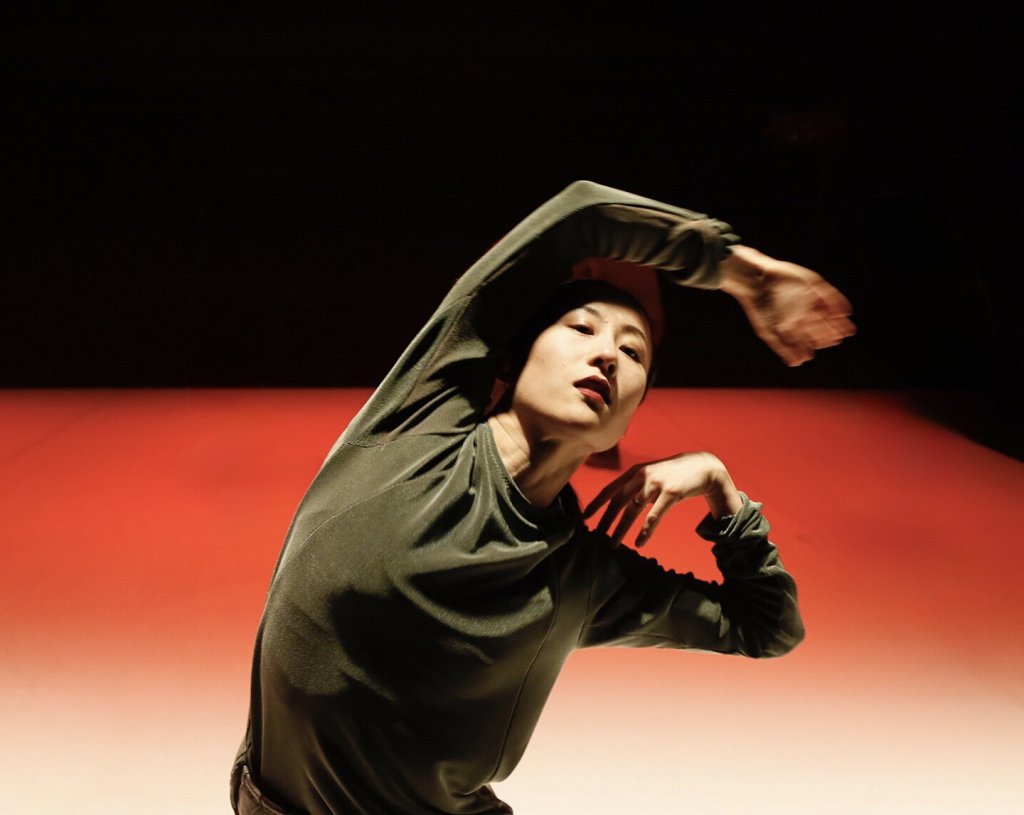
She trained as a ballet dancer in Madrid, spent a decade performing in New York, and came back to Spain to reinvent herself. This month, Geena Pacareu joined the IAB as guest choreographer for the second-year commercial dance students.
Geena Pacareu has built her career by saying yes to things she didn’t fully expect. A conservatory-trained ballet dancer who ended up in one of New York’s most physically demanding contemporary companies (Parsons Dance Company). A performer who had never acted or sung a note, who decided to audition for musicals anyway. A dancer who learned, sometimes the hard way, that no job – however prestigious – is responsible for keeping your passion alive. That part is on you.
She joined IAB Barcelona to choreograph an original piece for the second-year commercial dance students, and we sat down with her to talk about her journey, her philosophy, and what she wishes someone had told her at the start.
Who is Geena Pacareu?
Geena graduated from the Real Conservatorio Profesional de Danza in Madrid as a ballet dancer at eighteen. She then moved to New York, where she spent ten years performing with various companies in modern, contemporary, and neoclassical styles.
Five years ago, she returned to Spain, transitioned into musical theatre, and has been building a life as a teacher and choreographer ever since. “Right now I’m taking the time to teach, to choreograph, and to do my own things,” she says.
What is she creating for IAB students?
The piece is called Sinners: a choreography inspired by the film of the same name, which drew widespread critical acclaim earlier this year.
Geena was drawn in first by the soundtrack, and then by the film’s central theme: people creating music as an act of freedom in a place where they were not celebrated. “For the people around them, it looked dangerous – something connected to the devil,” she explains. “But for them, it was purely joy.”
That tension resonated with her personally. “I’m super active, super energetic – I dance constantly. For other people, maybe that seems like too much. But for me, it’s the way I feel free.” The piece lives exactly in that space.
How does Spain compare to New York?
Geena pushes back against the idea that returning home means stepping down. What she found surprised her.
“People ask me how it feels to come back, and honestly — it feels the same,” she says. “There is so much talent here that we are not even conscious of.“
The one real difference she notices is community. In New York, every class brings a completely new group of people and you establish yourself from scratch each time. In Spain, the scene is tighter and more interconnected. “Everyone knows each other here. That creates something different.“
Related Readings
→ Everything you need to know to work as an Actor in Barcelona

What made Parsons Dance a turning point?
Of all the companies Geena worked with in New York, Parsons Dance left the deepest mark – and she almost didn’t audition at all.
She walked in knowing little about the company, and walked out certain she had found something she hadn’t been looking for. “I called it my dream job without knowing it,” she says.
The work is intensely physical: big shapes, big jumps, complex partnering – and demands a quality of presence that makes eight dancers feel like twenty-five. For a ballet-trained dancer, it was a complete shift. “David Parsons stands in front of you and proves you can do more than you think. The company just makes you greater, over time.“

Parsons Dance
- Founded: 1985 by choreographer David Parsons and lighting designer Howell Binkley
- Location: New York City
- Artistic Director: David Parsons
Parsons Dance is a renowned contemporary dance company founded in 1985 in New York City by choreographer David Parsons. Celebrated for its high-energy, athletic, and joyful style, the company blends virtuosic technique, humor, and emotional depth.
Signature work: Caught (1982), the iconic strobe-light solo that creates the illusion of flying.
The company has performed in over 445 cities across 30+ countries on 5 continents, including The Joyce Theater, Kennedy Center, and Sydney Opera House. In 2025-2026, it celebrates its 40th anniversary with new creations.
How did she break into musical theatre?
When Geena returned to Madrid, she had no singing or acting experience, and musical theatre was where the most stable work was. Her response was straightforward: she started over.
She took singing lessons (“I’m not that good, but I really tried“), found teachers she connected with, and committed to taking class long before any audition was on the horizon. One of those teachers was choreographer Iker Karrera, whose work she followed consistently for months.
When the Mamma Mia casting came, she didn’t get through the first time. She went back the following year and was hired.

Being part of a long-running production was unlike anything she had experienced before. “It’s not just my responsibility on that stage,” she says. “There are lights, sound, actors, costumes – a whole world. And at the same time, every single one of us matters completely.”
She also discovered something about sustaining quality over repetition: doing the same show every night is not a reason to coast. If anything, it demands more: more class, more curiosity, more effort to show up fully every time.
She would do musicals again, and is training her voice. But with one condition. “I need to be dancing. Any musical that truly dances, I’ll be there.“
What does she wish she had known at the start?
This is where Geena gets most direct.
“You are responsible for your passion,” she says. “Not one job is going to make you happy. Not one job is going to sustain your love for dance through your whole career. That comes from you.“
She learned it the hard way – reaching milestones and still finding something missing. The answer was simple: she had stopped doing the things that made her love dance in the first place. Taking class for no reason. Moving with friends. Dancing without an agenda.
“Don’t think that getting a musical or a company job means you’re fine and you can stop,” she says. “Two years later, I promise you, you won’t be dancing anymore.”
Related Reading
What advice does she have for graduating students?
Her second piece of advice is about staying open.
“When you’re almost graduating, you have a list of four or five dreams, four or five auditions you’re going to do,” she says. “I would tell you to loosen that list.“
None of her jobs were what she had originally imagined for herself. She went to auditions without fixed expectations, got hired, and found herself in experiences that became defining chapters. “You might think you want to dance for an artist, and then you walk into a company audition and realise it’s exactly where you belong.“
The industry is too unpredictable to navigate with a rigid map. “Let life surprise you,” she says. “You will find yourself in a dream without even knowing it was the one you wanted.“

Geena Pacareu is a professional dancer, teacher, and choreographer based in Madrid. She worked with IAB Barcelona’s second-year commercial dance programme students on her original piece, Sinners, performed at the CONVERGE 2026 Show.
Interview by Zeb Díaz
Article by Sara Barbieri
Videography by Roger Bayerri