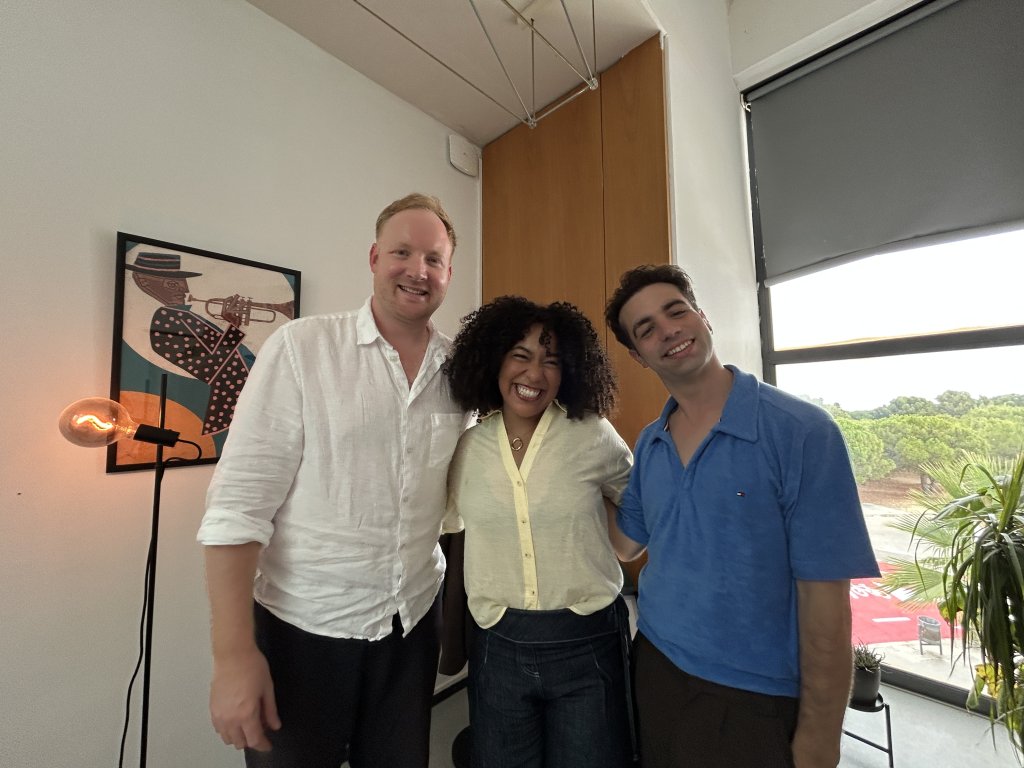
He grew up in Sabadell, graduated from Berklee College of Music, and has spent the last eight years building a career in New York that has taken him from Off-Broadway workshops to the pit of some of the biggest shows on Broadway. Abel Garriga – pianist, orchestrator, and Associate Music Director of Hell’s Kitchen and Water for Elephants – sat down with IAB’s Musical Theatre students for one of the most candid and wide-ranging conversations of the year.

Abel Garriga was born in Sabadell and graduated from Berklee College of Music in Boston in 2017. Before making it to Broadway, he cut his teeth directing musicals in Barcelona – Next to Normal, Bare: A Pop Opera, and Carousel at the Festival Grec – before moving to New York, where he worked his way up through Off-Broadway productions including Afterwards at Second Stage and Only Gold at MCC Theater. His Broadway credits include Water for Elephants as Associate Music Director and Keyboard 2, Hell’s Kitchen as Associate Music Director and Keyboard 3, and Moulin Rouge! as Keyboard 2 substitute and rehearsal pianist. He also served as Conductor and Music Assistant on Funny Girl – becoming the first Spaniard to conduct an orchestra on Broadway.
He has been based in New York since 2017, working alongside artists he admired as a child and some of the best professionals in the world. During a visit to IAB Barcelona, he sat down with the Musical Theatre students for an open conversation that covered everything from the mechanics of Broadway pit life to the realities of building a sustainable career – in New York and in Spain.
Moulin Rouge vs. Hell's Kitchen: Two Jukebox Musicals, Two Very Different Approaches
The conversation opened with a question that gets to the heart of Abel’s work as a music director: how do you approach a jukebox musical when the songs already exist and the audience already knows them?
His answer draws a sharp and illuminating distinction between the two shows he knows best. In Moulin Rouge, the songs came first – chosen by music supervisor Justin Levine based on what would serve the story and what rights could be secured. The process was curatorial. “The music is a vehicle,” Abel explains, “but it’s not really telling the story, because the songs were completely written by the time they were used.“
Hell’s Kitchen, by contrast, operates differently even though it also draws on existing music. Because composer Alicia Keys was in the room throughout the process, songs could be shaped, questioned, and refined in real time. “When you have the composer in the room, you can ask questions. You can provide – not feedback exactly – but what’s serving you and where your struggles are.” For Abel, having Keys present wasn’t just a creative luxury; it was a fundamentally different way of working with material.
The lesson he draws for students is direct: always bring your own version. “Nobody’s interested in a photocopy of somebody else,” he says. “Bring me your version – because that’s what’s going to make you shine.“
Broadway vs. Spain: It Comes Down to Resources
Having worked extensively in both markets, Abel is frank about the differences and equally frank about where those differences come from.
“It all comes down to resources,” he says. The US has been investing in musical theatre infrastructure for far longer than Spain, which means bigger budgets, larger orchestras, stronger unions, and more capacity to attract the talent needed to put on a show. “The amount of money they have to put up a production is way higher – which makes it easier to cast, easier to get the resources you want.“
He also points to the role of unions as a structural difference that matters more than it might seem. In the US, the musicians’ union protects live performance in ways that directly affect artistic quality. He gives a telling example: when the UK production of Heathers came to Broadway with pre-recorded vocals, the union stepped in. “They were like: no, they cannot do that.” In Spain, those protections are weaker which has real consequences for working conditions and salaries.
None of this is meant to discourage students from aiming at New York. But Abel is honest: “You really, really need to want it. The competition is high.” His most practical advice for anyone thinking about making the move is deceptively simple – find a job that pays the bills without pulling you off your path. “I’ve seen a lot of my friends get lost because they find a job and then they stop going to class, stop going to auditions.” Piano teaching worked for him. Tutoring works for others. The point is flexibility, not prestige.
Every Day Is a Job Interview
One of the most revealing moments in the conversation comes when Abel describes what it actually feels like to work on a Broadway show day to day.
“Every day is a job interview: for good and for bad,” he says. The good: a bad day doesn’t define you, because the next day is a fresh start. The bad: the pressure never fully lifts. His advice to anyone joining a production is to be prepared – not because everything will be handed to you, but because being ready makes the work better and the experience more enjoyable. “If you know the score ahead of time, it’ll be easier for everybody, for you and for the production.“
He is also disarmingly honest about the importance of asking questions. “Don’t be afraid to ask. If they hired you, they think you know how to do the job and knowing how to do the job includes asking what you don’t know.“
Stunt Casting: A Complicated Truth
Few topics in musical theatre are more contested than stunt casting and Abel addresses it with a nuance that clearly comes from having lived it from the inside.
He is clear that it is a real issue: he knows performers who lost roles to celebrities, and he has seen the cost of that firsthand. But he refuses to be simply cynical about it. “A Broadway show is what 50, 70, 80 people working – and sometimes these people need to feed their families.” Shows need to sell tickets. Celebrities sell tickets.
More interestingly, he points to the ways stunt casting can expand audiences in genuinely meaningful ways. Hell’s Kitchen is his example. “Every night I would walk in and that line was 90% black people.” That, he says, is almost entirely attributable to Alicia Keys and it represents something important. Bringing new audiences into theatres, people who wouldn’t otherwise see themselves reflected in musical theatre, is not nothing.
His conclusion is not that stunt casting is good or bad. It is that it is complicated and that anyone building a career in this industry needs to understand the economics well enough to navigate them with open eyes.
Stay Curious. Keep Learning. Have a Life.
Abel’s broader advice for students, whether they’re heading to New York or building careers in Spain, comes back to a single word: curiosity.
“In order to have a long career, you either need to be a celebrity or you need to be very curious.” The industry changes. What works now: a particular sound, a particular movement style – may not be what’s needed in five years. The performers and musicians who last are the ones who keep adding skills, keep showing up to workshops, keep learning things they don’t yet need but one day will.
He gives the example of the gymnasts in Water for Elephants, who hadn’t used their skills in twenty years before a Broadway circus show needed them. “Any skill you can bring – an instrument, a special skill, circus, gymnastics – you never know when it’ll come back to you.“
And finally, perhaps the most personal piece of advice: have a life outside the industry. New York can consume you if you let it. Social media makes it worse, showing you what everyone else is doing without showing you what they’re not doing. “Find a goal that keeps you sane mentally,” he says. “It’ll save you a lot of therapy time – and therapy money.“
Abel Garriga is a pianist, orchestrator, and Music Director based in New York City. His Broadway credits include Hell’s Kitchen, Water for Elephants, Moulin Rouge!, and Funny Girl.
Interview by Graduating Musical Theatre students
Article by Sara Barbieri