What does a Musical Director do?
Much More Than the Person Sitting at the Piano or Waving a Baton
After more than three decades working in musicals, concerts, television and large-scale productions, there is one question I still hear frequently from students and young performers:
What exactly does a musical director do?
It’s a fair question. From the outside, it often looks as though we are simply the person playing the piano during rehearsals or the one raising a baton when the performance begins. But the reality is considerably more complex.
In fact, a large part of our work takes place when nobody is watching.
By the time an actor walks into a rehearsal room for the first time, the musical director has very likely already spent weeks studying the score, meeting with the director, speaking with the choreographer, reviewing materials, adjusting keys and making decisions that will influence the production long before the first note is heard.
A musical director (MD) is the person responsible for the musical identity of a live production – preparing the score, coaching performers, adapting arrangements, leading the band or orchestra, and making sure every musical choice serves the story. In modern musical theatre, the role often extends far beyond conducting to include arranging, orchestration, copying parts, music production, and sometimes composing original music.
Throughout my career, I have had the opportunity to work on a wide range of productions. From musicals such as Evita, Cabaret, Sunset Boulevard and The Phantom of the Opera, to symphony concerts, television programmes and large-scale international events.
And if there is one thing all of these projects have taught me, it is that music never functions in isolation. It is always in service of something greater: a story, an artist, an emotion, or a shared experience with the audience
That is why I would like to use this article to offer a small glimpse into a role that often remains unseen.
Key Takeaways
- A musical director’s real work begins weeks before rehearsals, studying the score, meeting the director and choreographer, and adjusting keys and arrangements.
- During rehearsals, an MD is listening for storytelling, not just accuracy – phrasing, breath, dramatic intention, and the relationship between text and music.
- The modern musical director often also works as an arranger, copyist, orchestrator, music producer, and sometimes composer – roles that used to belong to separate specialists.
- The sitzprobe (the first rehearsal with full orchestra) is widely considered one of the most pivotal moments of a production for both performers and the MD.
- Long-term success in the industry depends less on raw talent than on punctuality, listening, humility, and how you handle setbacks – reputation travels faster than a résumé.
What a Musical Director Does Before Rehearsals Begin
One of the biggest surprises for many students is discovering just how much work takes place before the first rehearsal. When I receive a new production, my first task is not to sit at the piano. It is to sit down with the score. And a musical theatre score is not simply a collection of songs. It is a complete dramatic work.
You need to understand what each musical number is telling us, how each character develops, where the points of tension lie, which transitions may create problems, and which moments are likely to be the most demanding for the cast.
Practical questions come up constantly:
- Does the original key work for the performer we have?
- Do we need to adapt any of the arrangements?
- Will it be necessary to adjust tempos to accommodate particular staging requirements?
I remember that on several major productions, we discovered during the preparation phase that small musical adjustments could make the performers’ work considerably easier later on. These are decisions that the audience never notices, but which ultimately have a huge impact on the final result.
Meetings with the director and choreographer are also essential
Many students imagine that each department works independently. In reality, the exact opposite is true.
The music influences the movement. The movement influences the dramatic pacing. And the dramatic pacing ultimately affects the musical decisions.
When a production works well, it is usually because all of those conversations have taken place long before the first rehearsal begins.
What Your Musical Director Is Thinking While You Sing
This is often where one of the biggest differences appears between what a student thinks is happening and what is actually happening.
Many performers assume that the musical director is mainly listening to whether they are singing in tune. The reality is that, in a professional environment, I generally take it for granted that the notes will be there. What interests me is something else:
While someone is singing, I may simultaneously be listening to the pitch, rhythm, phrasing, diction, breathing, dramatic intention, and the relationship between the text and the music. And very often, what interests me most is not what is happening, but what is not yet happening.
I have experienced countless situations in which an actor performed a song perfectly from a technical point of view and yet the scene still did not quite work.
What was the problem?
They were singing the notes, but they were not communicating the story. And that difference is enormous.
One of the most difficult things to teach in musical theatre is that music and acting are not separate departments. Music acts as well. Music tells the story too.
That is why some notes can seem obsessively specific. I am not correcting a breath for the sake of it. I am trying to help an emotion reach the audience more effectively.
How to Build a Great Working Relationship with Your Musical Director
If I had to summarise it in a single word, it would be: trust.
Over the years, I have worked with extraordinary artists. Some had exceptional voices. Others had more limited resources.
But if you asked me which quality I value most in a performer, I would probably answer without hesitation: the ability to listen.
The artists who grow the most are those who arrive prepared, ask questions, take notes, and understand that a rehearsal is not an examination. It is a laboratory – a place to try things out, to make mistakes, and to discover new possibilities.
By contrast, there are few things more difficult than working with someone who arrives convinced that they already know everything.
Curiosity is a far more powerful tool than perfection.
And, interestingly, the performers who understand this are usually the ones who stand out the most in the long run.
The Sitzprobe: The Day Everything Changes
If I had to choose one of my favourite moments in any production, it would probably be the sitzprobe.
Sitzprobe (German for “seated rehearsal”) is the first time a cast sings with the full orchestra – and if I had to pick one favourite moment in any production, it would be this one.
I have seen actors arrive at that rehearsal feeling completely confident and leave it with a mixture of excitement and apprehension – and that is perfectly normal.
For weeks, they have been working with nothing more than piano accompaniment. Then suddenly a full orchestra appears. The same song they thought they knew sounds different. The colours change. The points of reference change.
The energy changes.
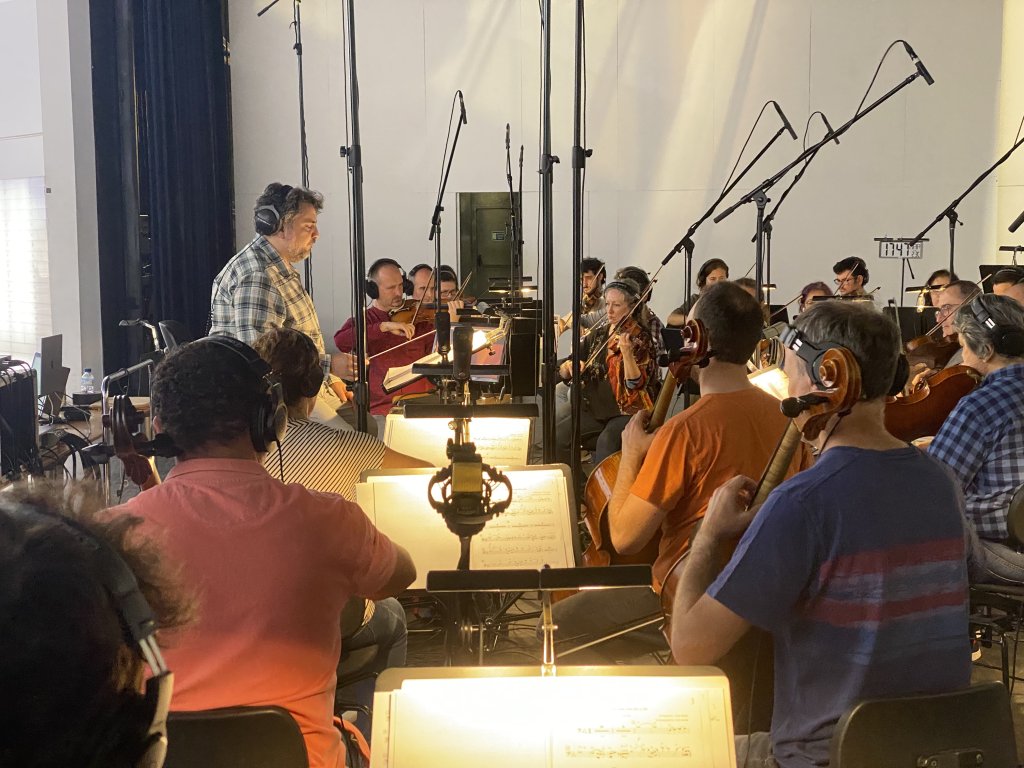
I remember the first time some performers heard certain sections of The Phantom of the Opera played by the full orchestra. Their reaction was almost physical. In that moment, they truly understood the scale of the score they had been working with.
For the musical director, the sitzprobe is a combination of celebration and final examination. It is the moment when all the pieces begin to fall into place, and also the moment when unforeseen problems emerge.
That is why it is one of the most exciting and exhausting days of the entire process. And precisely for that reason, it is also one of the most unforgettable.
The Musical Director Today: Much More Than a Baton
How a musical director profession has changed and can no longer be defined in a single way
When people hear the term musical director, they often imagine someone standing in front of an orchestra, conducting with a baton, or sitting at the piano during rehearsals. And while that image is not incorrect, it stopped telling the whole story a long time ago.
The reality is that the role of the musical director has changed enormously over the past few decades. Today, particularly in musical theatre and contemporary stage productions, the musical director often takes on responsibilities that were once shared between several different professionals.
In many projects, the musical director is no longer solely responsible for directing the music.
When Each Role Had a Specialist
A few decades ago, large productions typically relied on highly specialised teams:
- The composer wrote the music.
- The arranger developed the material.
- The orchestrator distributed the ideas across instruments.
- The copyist prepared individual parts for musicians.
- The musical director coordinated and interpreted all of it.
Each professional occupied a very specific space within the creative chain.
I have been fortunate to work in a period in which this transformation has taken place before our eyes. And if there is one thing I have learned, it is that the definition of a musical director today is far broader than many students imagine.
That model still exists in some large international productions, but the reality of most current projects is different. Budgets are tighter. Timelines are shorter. And technological tools now allow a single person to take on tasks that once required several departments.
The Musical Director as an Arranger
One of the areas that has grown the most in recent years is the role of the musical director as an arranger.
Today, it is very common to find yourself needing to adapt a song for a specific cast, change a key, create a new introduction, reduce an orchestration, expand a musical sequence, or simply find a different way of presenting existing material.
In these cases, the musical director is often the person best placed to make those decisions. They know the work in depth, they know the performers, they understand the staging requirements, and they are aware of the real possibilities of the musicians who will be in the pit or on stage.
For this reason, arranging is often not about writing more notes, but about finding the right notes so that the music fulfils its function in the most effective way possible.
The Musical Director as Copyist
This is a far less visible task for the audience, but no less important.
When a score reaches a musician’s stand, it must be clear, precise and easy to read. A small notational error can lead to minutes of confusion during a rehearsal. If we multiply that by twenty musicians over several weeks of work, that small error is no longer so small.
For this reason, many musical directors also become involved in the preparation and revision of materials. They review parts, correct markings, adjust formatting, and ensure that each musician has exactly the information they need.
It is silent work, and largely invisible. The audience will probably never know it exists, but musicians appreciate it every day.
The Musical Director as Composer
Perhaps this is the most interesting evolution of all.
There often comes a point when many musical directors develop such a deep understanding of dramaturgy, arrangement and the needs of a production that they begin to feel the need to write their own music.
It is not unusual. In fact, it is quite logical. After years of analysing scores, solving musical problems and taking part in creative processes, many of us develop our own voice.
In my case, composition has always coexisted with musical direction. They are different disciplines, but deeply connected. Musical direction has taught me to understand how music functions within a production, while composition has allowed me to create that material from its origin. One discipline constantly feeds the other.
How Technology Has Changed the Rules of the Game
There is also an unavoidable factor: technology.
Today, a musical director can work from a computer using tools that, only a few decades ago, would have seemed unimaginable. They can write scores, generate orchestral mock-ups, edit audio, program sequences, prepare materials for a full orchestra, and share them instantly with musicians anywhere in the world.
These tools have greatly expanded creative possibilities, but they have also increased responsibilities. Today, musical directors are expected to master skills that once belonged to entirely separate departments. Technology has opened new doors, but it also demands increasingly broad training.
What Skills Does a Musical Director Need?
If I had to give advice to students interested in musical direction, it would be simple: do not limit yourself to learning just one thing.
Study harmony. Learn orchestration. Become familiar with music technology. Explore composition. Learn how to write for real musicians and prepare professional materials. And above all, learn to listen.
The modern musical director is, in many ways, a translator. Their job is to transform artistic ideas into a concrete sonic reality. The broader their musical and technical language, the more tools they have to do so.
The Future of the Musical Director Role
How Technology Changed the Job
Perhaps the most fascinating thing about this profession is that it never stops changing. What we consider normal today would have seemed extraordinary thirty years ago, and in another thirty years it will almost certainly change again.
However, one thing remains constant.
Whether conducting an orchestra, writing an arrangement, preparing a part, or composing a new work, the goal is always the same: to use music to move, communicate, and tell stories.
As long as that need to communicate and move audiences through music exists, the role of the musical director will continue to evolve and find new ways to add value to every production.
Building a Career as a Musical Director: Talent Opens the Door, Character Decides How Long You Stay
To close this article, I want to share how I believe a lasting career can be built.
Throughout my career, I have worked with extraordinary artists. Some had impressive voices. Others had impeccable technique. Some were brilliant musicians. Others had a natural charisma capable of filling an entire theatre.
However, after more than thirty years working in musicals, concerts, television and large-scale productions, I have reached a conclusion that may surprise many young artists: talent is not the most important thing.
Or rather: talent is essential, but it is not enough.
There is a phrase I have repeated for years that sums this up perfectly:
“You are hired for your talent, and dismissed for your character.”
It may sound harsh, but experience has shown me time and again that it is true.
When someone attends an audition, secures a role, or joins a production, they have usually already demonstrated that they possess the necessary skills to be there. They have sung well, acted well, or shown the required technical level. But once the job is secured, another and far more important evaluation begins.
The human one.
Related Readings —>
Nobody Works Alone
An artistic production is, by definition, a collective effort. Whether it is a musical, a concert, a recording session or an international tour, there is always a team behind every project. And the more professional that team is, the more important the relationships between its members become.
Over the years, I have seen that producers, directors, musicians and hiring managers all understand that talent alone, however extraordinary, is not the only factor that determines the success of a production. What is truly difficult is finding people you can work with comfortably for weeks or even months — people who arrive prepared, who respect their colleagues, who know how to listen, and who maintain a professional attitude even when problems arise. Because moments of tension happen in every production, without exception.
Punctuality Is a Form of Respect
One of the first things any professional team notices is punctuality. Many young artists believe that arriving five minutes late to rehearsal is not particularly important, but the reality is very different.
When you are late, you are not only wasting your own time; you are wasting everyone else’s. You are delaying colleagues who arrived on time and forcing a reshaping of a process that depends on collective coordination.
That is why I have always believed punctuality sends a very simple message:
“I respect your work.”
And in a profession built on trust and teamwork, respect is an invaluable currency.
Listening Is Also an Artistic Skill
Many performers spend years developing their voice, refining their technique, or improving their stage presence. All of that is essential. However, one skill is rarely discussed and is just as important: the ability to listen.
- Listen to the director.
- Listen to the musical director.
- Listen to your colleagues.
- Listen to what is happening on stage.
- Listen to a note without immediately becoming defensive.
The best artists I have worked with have not always been the most technically virtuosic. Very often, they have been the best listeners – those who understand that feedback is not a personal attack, but an opportunity to grow.
The ability to listen carefully, absorb information and transform it into artistic improvement is one of the key qualities that separates professionals who continually evolve from those who eventually become stuck.
Ego Is a Bad Travel Companion
Confidence is necessary. An unchecked ego is destructive.
There is a huge difference between believing in yourself and believing there is nothing left to learn. In my experience, the artists who grow the most are often the most humble – not because they undervalue themselves, but because they keep their curiosity alive. They continue asking questions. They continue learning. They continue looking for ways to improve.
Meanwhile, some highly talented artists become stuck because they stop listening. And when that happens, their growth stops too.
A Personal Story
When I was very young and starting out as a conductor, I made a mistake that I think is quite common. I worried about almost everything happening in a production. If there was a technical issue, I worried. If another department encountered a problem, I worried. If something did not go exactly as planned, I felt that, in some way, it was my responsibility.
I experienced performances with constant tension because I was trying to keep track of too many things at once — things that, in reality, were neither my responsibility nor within my control.
I remember a conversation I had at that time with a close friend of mine who is a psychologist. After a performance, I started telling him everything that had gone on. I spoke about technical problems, organisational issues, situations in other departments, and everything that was worrying me.
He listened patiently for a while and, when I finished, he asked me a question with a hint of irony that I have never forgotten:
“And of course… all of that is your responsibility, is it?”
That question made me reflect deeply. Suddenly I realised I was spending enormous energy trying to control aspects of the production over which I had neither direct responsibility nor full knowledge.
Over time, I learned a lesson that has stayed with me throughout my career: my job is not to control everything that happens in a performance. My responsibility is to take care of my own area to the best of my ability.
I need to make sure the music works. I need to ensure my department is prepared. I need to make my work shine and integrate seamlessly with the rest of the production. But I do not need to control what belongs to others or intervene in processes whose details I do not fully know.
Paradoxically, when I stopped trying to control everything, I became a better director. I was able to focus my energy on what truly depended on me and trust that others would do the same in their own areas.
Over the years, I have come to understand that a good production does not come from one person trying to oversee everything. It comes from each department doing its job excellently and everyone being able to collaborate and align with one another.
Learning to trust the professionals around you is one of the most important lessons this profession has taught me.
How You React When Things Go Wrong
The true character of a professional does not appear when everything goes as planned. It is easy to maintain a good attitude when the applause arrives, when the director is satisfied, or when everything seems to be moving forward without difficulty. The real test comes when things become complicated.
It appears when you receive unexpected criticism. When you lose a role you thought was secured. When you have to repeat a scene twenty times because it still does not work. When a performance does not go as you imagined, or when someone corrects you in front of your colleagues.
It is precisely in those moments that we see who is ready to build a long career.
Professional maturity lies in understanding that problems are not an exception in this profession; they are part of the process. They have always been there, and they will always be there. The important thing is not to avoid obstacles, but to learn how to respond to them with intelligence, humility, and professionalism.
Reputation Travels Faster Than You
There is something many young artists discover too late: in this profession, everyone talks to everyone else.
Directors speak to other directors. Musicians speak to other musicians. Producers speak to other producers. And information circulates much faster than most people imagine.
When someone is hardworking, respectful, punctual, and professional, that reputation spreads. But the same happens when someone constantly creates conflict, arrives late to rehearsals, or makes collaboration difficult.
The artistic industry is much smaller than it appears from the outside. That is why every rehearsal, every performance, and every collaboration contributes to building your professional reputation. Long before anyone sees your CV, they may already have heard about you.
What People Truly Remember
Over the years, I have noticed something very interesting. Very few people will remember whether you sang a slightly out-of-tune note one day or made a small mistake during a performance.
However, they will remember how you treated your colleagues. They will remember whether you were willing to help when needed. They will remember whether you maintained a positive attitude in difficult moments. They will remember whether you were someone they could rely on when problems arose.
Talent impresses. Character lasts.
And when a production ends, that is often what remains in the memory of those who worked with you.
A Career Is Built Every Day
When we are young, we often think our career will depend on one great opportunity: an important audition, a leading role, a special concert, a project capable of changing everything overnight.
With time, you discover that lasting careers are built differently.
They are built rehearsal by rehearsal, performance by performance, decision by decision, attitude by attitude.
And here we return to a phrase I have repeated for years, and which perfectly summarises what I have learned from observing hundreds of artists throughout my career:
“You are hired for your talent, and dismissed for your character.”
Your talent will open doors. Your preparation will help you walk through them. But it is your behaviour towards others that will determine how long you remain in the artistic and professional world.
And that, in a profession built on trust, coexistence, and teamwork, can make the difference between getting a job and building a career.
Famous Musical Directors
Paul Gemignani
Widely regarded as one of Broadway’s most influential musical directors, Gemignani has worked on Broadway and in the West End for over forty years. He is best known for his long partnership with Stephen Sondheim, having led Tony-winning productions including A Little Night Music, Sweeney Todd, Into the Woods and Assassins. He received the Tony Award for Lifetime Achievement in the Theatre in 2001 and was inducted into the American Theatre Hall of Fame in 2010.
Alex Lacamoire
A composer, arranger, conductor, musical director and orchestrator who has worked extensively on and off Broadway. He is a multiple Tony and Grammy Award winner for his work on In the Heights, Hamilton, and Dear Evan Hansen, and received the Kennedy Center Honor in 2018. He served as music director, orchestrator, and conductor for Hamilton, later moving into a music supervisor role.
Stephen Oremus
An American musician who has worked on Broadway as both musical director and orchestrator, best known as the original music director and arranger of Wicked, a role he’s held since the show opened. His orchestrations for The Book of Mormon and Kinky Boots each earned him a Tony Award for Best Orchestrations. He has also served as music director for major television broadcasts including the Academy Awards, and conducted the orchestral recordings for Disney’s Frozen films.
Kristen Blodgette
Spent 35 years as associate musical supervisor and conductor of Andrew Lloyd Webber’s The Phantom of the Opera on Broadway, and supervised 18 productions of the show worldwide. She has also served as musical director for revivals of Sunset Boulevard, Cats and Evita, and currently conducts the Broadway revival of Sweeney Todd. Her Phantom connection began in 1984 conducting the national tour of Cats, after which musical supervisor David Caddick brought her on as his associate on Phantom.
FAQ: Common Questions About Musical Directors
What does a musical director do?
A musical director prepares and interprets the score for a production, coaches performers on musical and dramatic delivery, adapts arrangements and keys to the cast, and leads the band or orchestra during rehearsals and performances. In modern musical theatre, they often also arrange, orchestrate, prepare musical parts, and sometimes compose original material.
What is the difference between a musical director and a conductor?
A conductor primarily leads live musicians during a performance. A musical director typically has broader responsibility across the entire production — score preparation, casting-related musical decisions, coaching, arranging, and coordination with the director and choreographer — in addition to conducting.
What is a sitzprobe?
A sitzprobe (German for “seated rehearsal”) is the first rehearsal where the cast sings with the full orchestra, usually without staging. It’s often the moment performers first hear the true scale and colour of the score.
Do musical directors write their own arrangements?
Increasingly, yes. Many modern musical directors also work as arrangers — adapting keys, orchestrations, and musical sequences for a specific cast and production — a task that used to belong to a separate specialist.
What skills does a musical director need?
Beyond conducting and piano skills, a modern musical director typically needs strong score-reading and harmony knowledge, arranging and orchestration ability, familiarity with music production technology, and — just as importantly — the interpersonal skills to collaborate closely with directors, choreographers, and performers.
What matters more in a music career - talent or character?
Talent gets you hired; character determines how long you stay. Reliability, punctuality, the ability to listen to feedback, and how you handle setbacks tend to shape a long-term career more than raw talent alone.