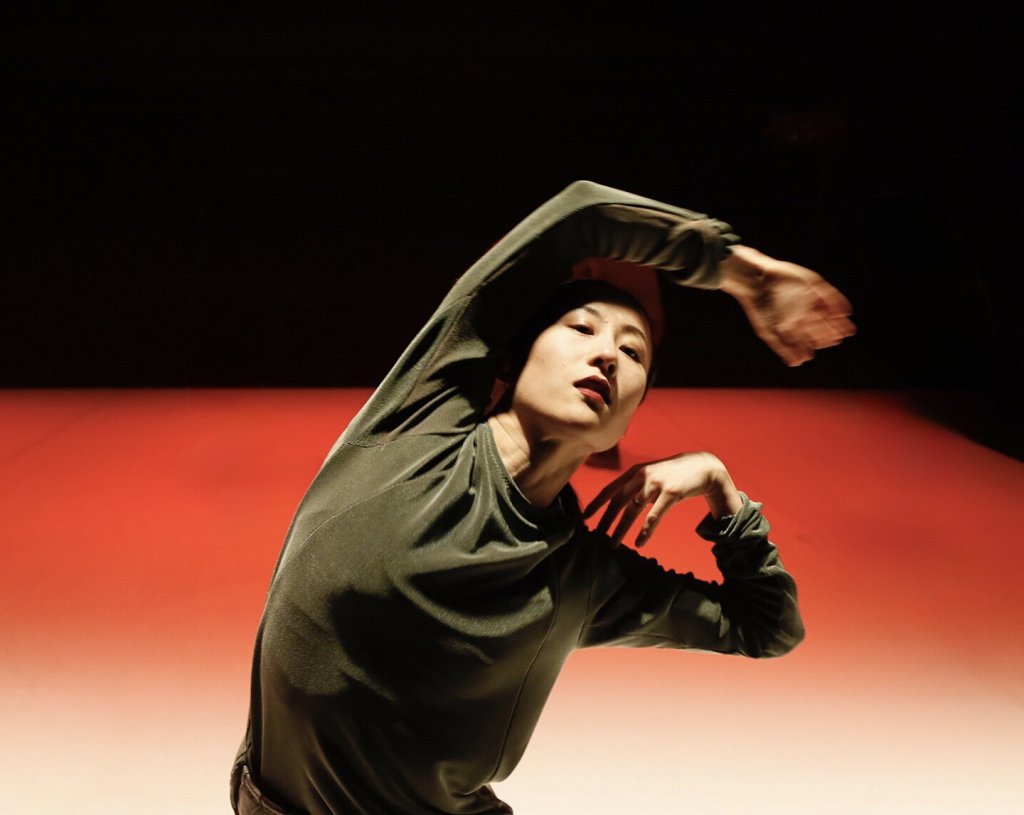
From a small village outside Lisbon to leading roles in Les Misérables, Cats, and Evita – Madalena Alberto has spent 25 years building a career on the West End as a foreigner in a foreign industry. During IAB Industry Week, she led a masterclass with IAB’s graduating Musical Theatre students, opening up about emotional surrender on stage, the loneliness of London, and what real confidence actually looks like.
Madalena Alberto was scouted in a small village just outside Lisbon and brought to London at a young age to begin a three-year Performing Arts degree. She has gone on to become one of the most prominent leading ladies in the West End, having played some of musical theatre’s most coveted roles: Fantine in Les Misérables, Grizabella in Cats, and the title role in Evita. Her career has also extended to screen, with appearances in BBC’s Holby City, Donmar Warehouse’s live broadcast of The Vote, and an upcoming role as DEA agent Gabriella Lunez in the second season of the BAFTA-nominated BBC series The Gold.
Madalena’s visit was part of IAB’s Industry Week 2026 – seven intensive days at the Sitges campus during which the regular timetable is replaced by workshops, masterclasses, and Q&A sessions led by international professionals. Within the Musical Theatre programme, she joined a line-up that included Gara Roda, director of Ànima at the Teatre Tivoli, Sergi Cuenca, longtime Musical Director for Disney’s The Lion King in Madrid, and Iker Karrera, choreographer for the Spanish productions of Wicked and The Book of Mormon. The week culminated in an Agent Panel Day attended by fourteen agencies – after which more than 80% of the graduating Musical Theatre cohort received offers of representation or professional contracts.
During her session, Madalena sat down with IAB’s graduating Musical Theatre students for an open Q&A, one that moved fluidly between technical advice, personal reflection, and remarkably candid honesty about the realities of a career on stage.
→ Related Reading: IAB Industry Week 2026
→ Related Reading: Graduating Students Visit Ànima at the Teatre Tivoli
How does she protect her mental health while performing emotionally intense roles eight times a week?
This was one of the first questions students asked – and Madalena’s answer evolved as she spoke through it.
She recalled an early period in her career, during Evita, when her worry wasn’t emotional but physical. Performing a character dying of cancer every night, she found herself wondering:
“Am I manifesting this? Is my body going to know that this is imaginary?“
A simple piece of advice from someone around her reframed it instantly – if she were playing an alcoholic, she reasoned, she wouldn’t actually become one. “That thought is just silly,” she says now, looking back.
But the deeper answer she offered was about surrender.
“For me, it is the complete surrender in the moment,” she explains. She described the final twenty minutes of Evita as dramatic, emotionally overwhelming, ending in a song called Lament sung as a ghost. When the pacing was right and she could fully give herself to the emotion, she would walk offstage and feel completely fine. When the pacing was off, and she couldn’t release everything the moment demanded, she would come out and start crying.
“I never felt that surrendering emotionally was bad for my mental health,” she says. “I never felt that.” The key, in her experience, was never holding back. Half-committing to an emotion – trying to perform it rather than feel it – was, for her, the riskier path.
She’s careful to note this isn’t universal. “Everybody’s different. Everybody’s got different triggers.” What worked for her may not work for every performer – but the principle of full commitment, rather than careful management, is one she has trusted for decades.
What is it like building a career as a foreigner in a country not your own?
Madalena moved to London twenty-five years ago, at a time when she says there were almost no other Portuguese performers in her world. She hadn’t set out to become a dancer, she calls it something she did “as a hobby”, until a faculty visit from Bird College changed the direction of her life entirely. They saw something in her during a workshop and offered her a scholarship, despite the fact that she had never had a singing lesson and barely knew what a musical was.
“In my time, there was no musicals in Portugal,” she says. “There was nothing.“
She is honest that being foreign came with real costs, certain jobs she likely didn’t get simply because she wasn’t seen as fitting a particular mould. But she also frames her difference as a genuine asset. At drama school, classmates worked hard to master the “proper English” accent expected of West End performers. Madalena, as a Portuguese actress with an American-inflected accent, didn’t see the point in chasing it.
“Why? Nobody’s going to cast me in an RP thing,” she remembers thinking. Instead, she leaned into sung-through musicals – shows like Les Misérables and Evita, where music can soften the edges of an accent – and turned not knowing the shows she auditioned for into a strength rather than a weakness.
“I think for some reason I saw that me being different could be a strength,” she says, while acknowledging that other performers have had very different, harder experiences with the same starting point.
Is the West End still "the" place to be?
Here, Madalena offers some of her most direct advice of the session, and it runs counter to what many students might expect to hear.
She is clear-eyed about the talent in the room. “I can tell that you guys are so, so talented,” she tells the students. “The standard here is probably way higher than it is in most colleges in London. But when you go to the West End, that is not reflected.” Many performers on West End stages, she says plainly, are not necessarily better than the students sitting in front of her.
Her broader point is about geography. “London is not the hub anymore. It’s not the centre of it anymore – or New York,” she says. She points to Spain as an example, recalling how the production team behind the Spanish staging of Les Misérables came directly from the UK to scout talent here, with several performers eventually crossing over to London productions as a result. She also references international productions in China and on cruise ships, noting that some cruise productions now rival West End theatre in quality.
Her advice isn’t to abandon West End ambitions, but to hold them more loosely.
“If you dream of going to the West End, of course, try – see what happens with visas, see what happens with agents,” she says. “But it’s not the be-all and end-all of everything.“
What is it really like to live far from home, in a culture that isn't your own?
This question, prompted by a Portuguese student reflecting on the warmth of her own culture compared to life abroad, drew one of Madalena’s most personal answers. She moved to London at seventeen, completely alone. Twenty-five years later, she admits she only recently began to feel London was home at all.
“It can be a lonely place,” she says. “It’s not a particularly sociable place, at least in my experience.” She mentions, almost in passing, how rarely she’s been invited to a friend’s house there compared to the closeness she associates with Portuguese or Spanish culture. It’s not, she’s careful to clarify, about glamour versus hardship – many of her colleagues in West End shows hold second jobs simply to afford living in the city. In recent years, she has found a kind of balance: a house in London that functions as a place to focus on work, and trips to Barcelona or Lisbon when she wants to reconnect with people and life outside the industry.
“If you’re doing something that you love, then you just forget about it,” she says of the loneliness. “But it is a thing.“
What advice does she have for performers who feel self-conscious or closed off?
Madalena’s answer here is grounded in something she has only recently begun to navigate herself: having developed panic attacks in the past three years, despite a long career built on stage confidence.
“I started having panic attacks the past three years. I’ve never had them in my life,” she shares. She describes an earlier mindset in which stepping on stage felt almost involuntary – “it’s life or death, I’m here, so I’ve got to do it” – leaving no space for self-doubt. More recently, that automatic certainty has occasionally given way to fear.
Her response has been pragmatic rather than dramatic. “It’s a choice,” she says. “I don’t have to do it. So if it’s something that you really love, you really want to do it, you just tell yourself: this is what I want to do.“
Her advice to students is built around repetition and exposure – singing whenever the opportunity arises, going to auditions, even just singing at karaoke – because confidence, in her experience, comes through doing rather than waiting to feel ready.
She’s candid that she doesn’t have all the answers, and that professional support matters. “It’s better to rely on people who are professionals and have the tools to help you,” she says, mentioning that she’s likely to seek out a therapist who specialises in performing artists. She’s tried affirmations, meditation, and other tools over the years – with mixed and uncertain results. “Maybe it’s a placebo,” she says. “I don’t know. It’s hard.“
What she’s certain of is this: technical confidence and emotional confidence reinforce each other. “It helps if you do a lot of class,” she says. “If you’re confident with technique, you’re not so scared when you go in front of people and sing.“
Madalena Alberto is a West End actress and singer known for leading roles in Les Misérables, Cats, and Evita. She led a masterclass with IAB Barcelona’s graduating Musical Theatre students during Industry Week 2026.
Q&A by Graduating Musical Theatre Students
Article by Sara Barbieri
Videography by Roger Bayerri