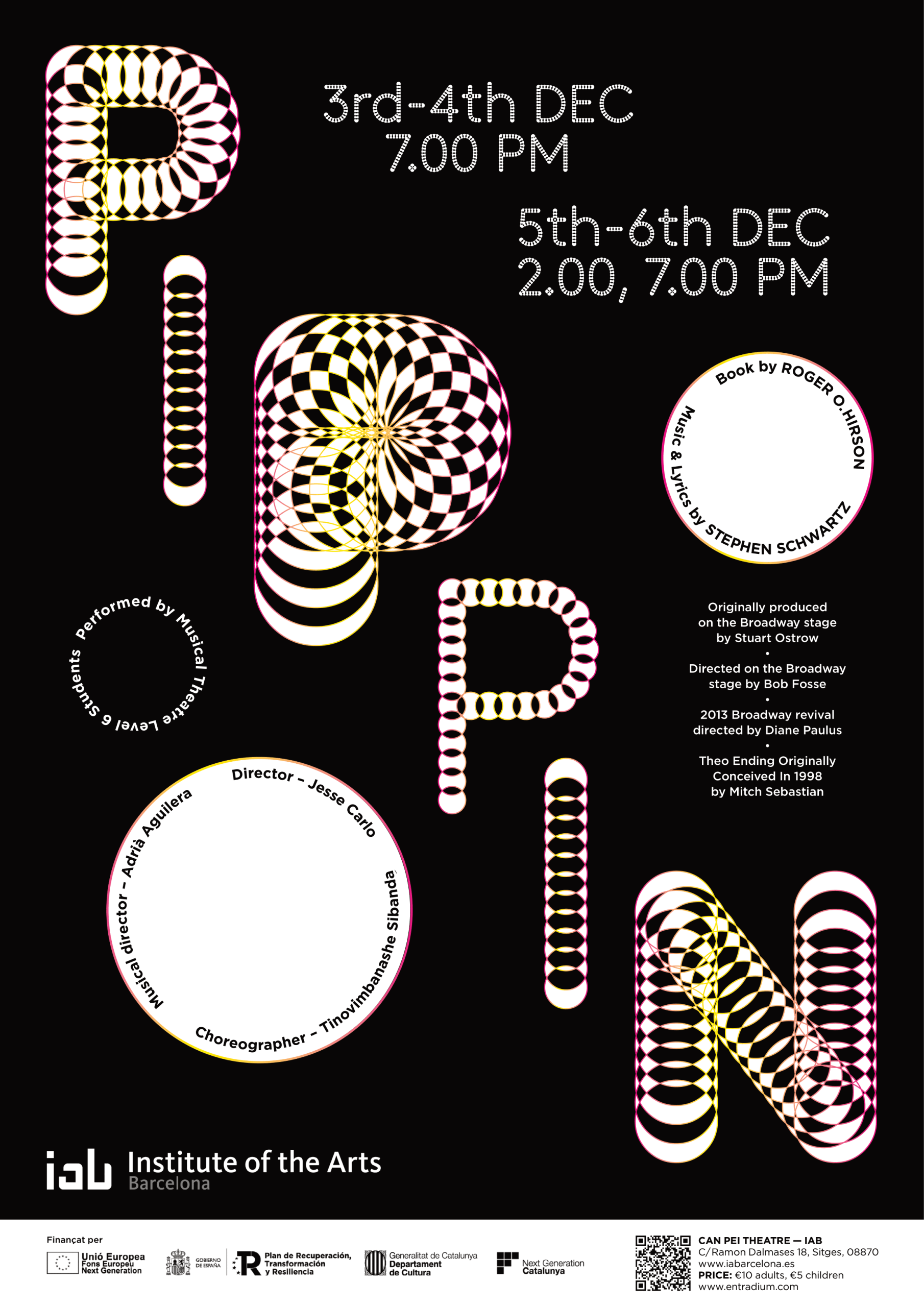
Pippin is a satirical, coming-of-age musical with music and lyrics by Stephen Schwartz. It tells the story of a young prince, Pippin—the son of Charlemagne—who longs to find his “corner of the sky” and lead a life of meaning. Guided by a mysterious troupe of players, led by the charismatic and manipulative Leading Player, Pippin explores various paths: war, politics, revolution, pleasure, and simple domestic life.
Despite these pursuits, he struggles to find fulfilment. Ultimately, when tempted with a dramatic, self-sacrificial “Grand Finale,” Pippin rejects spectacle and chooses a quieter, more authentic life with Catherine and her son. The ending challenges the nature of theatrical illusion versus genuine human connection.
Warnings & Cautions
The show combines spectacle, comedy and excitement, but also tackles mature themes. These include violence and war (depicted in a stylised manner), sexual innuendo, corruption and abuse of power, mortality and the search for meaning, and emotional manipulation. Flashing lights, loud noises, sudden darkness and an emotionally intense climax that emphasises feelings of isolation and despair are used on stage.
Please take note:

Director

Choreographer

Musical Director
Welcome to Pippin.
In a world that feels increasingly defined by uncertainty—political upheaval, widening inequality, climate anxiety, and the relentless pressure to “be extraordinary”—Pippin’s story lands with a fresh urgency. Its questions echo our own: What does it mean to live a meaningful life? Whose definitions of success have we inherited? And how do we unlearn the narratives that shrink our humanity?
This production was built through a practice rooted in radical pedagogy, a belief that the rehearsal room can be a site of liberation. We approached this process not as a hierarchy but as a collaborative ecosystem where each artist’s voice matters. We asked big questions together, made space for uncertainty, and embraced the friction that comes with honest inquiry. The goal was not perfection—it was awakening.
At the center of our work was radical love. Not love as sentimentality, but love as an ethic: a commitment to seeing and valuing each other fully, especially in a time when global narratives encourage division and dehumanisation. In a world that tells us to guard our hearts, we practised opening them. We learned to care for one another fiercely, to apologize bravely, to create boundaries tenderly, and to hold space generously. This musical reminds us that connection is not a distraction from the great work of our lives—it is the great work.
And finally, we cultivated radical joy. Not joy as escape, but joy as resistance. Joy as the reclaiming of breath in a time when so many feel suffocated. Joy as a birthright that cannot be stolen by despair. Joy as the quiet revolution that allows us to imagine a world beyond scarcity, domination, and fear.
Through this lens, Pippin becomes more than the tale of a young person searching for purpose. It becomes an invitation—to reject the myth that our worth is tied to spectacle, achievement, or greatness. It asks us instead to cherish the simple, the quiet, the present, and the tender. It reminds us that the extraordinary can be found in the ordinary, and that fulfilment often arrives not with a bang but with a gentle exhale.
As you watch this story unfold, I invite you to listen for the questions beneath the choreography, the heartbeat beneath the harmony. Consider what it means to craft a life of intention rather than one of spectacle. Consider what you might need to let go of. Consider what you might dare to imagine.
Thank you for joining us. May this performance encourage you to seek wonder, practice compassion, and claim your own small, radiant moments of joy.

The show will be performed the following dates:
Subscribe to our email list
Be the first who finds out about our shows