Călin Ciobotari BIO
Călin Ciobotari, PhD, Director of the Doctoral School of Performing Arts, “George Enescu” National University of Arts, Iași.
- Theatre critic, professor, and PhD supervisor at the Faculty of Theatre.
- Associate Professor at the Faculty of Philosophy and Social Political Sciences, Alexandru Ioan Cuza University, Iași.
- Member of the International Association of Theatre Critics, the Romanian Theatre Union, and the Romanian Writers’ Union.
- Author of over twenty books.
- Editor-in-Chief of Dacia Literară magazine and producer/host of The Stage (Apollonia TV Iași).
- Winner of the UNITER Award for Theatre Criticism in 2019 and 2022.
- Served as Director and Curator of the National Theatre Festival in 2020 and 2022.
- Notable publications: The Marginals of Chekhov (2016), The Director and the Text: Reading Practices (2017), Hamlet in the Cherry Orchard (2018), and Rereading Gorky: A Theatre on the Brink of Crisis (2021).
- His current research focuses on Aesthetics, Drama Theory, and Spectacology.
Interview
What first inspired you to become a theatre critic? Was there a particular performance or encounter that made you realise this was your path?
Călin Ciobotari explained with a smile that his relationship with theatre was not immediate or straightforward. He did not fall in love with it at first sight, describing his journey as complex and evolving over time. However, he shared that, at present, he feels he is in the right place with this profession – “in the right story, the right film.” While the work can bring him happiness, he remains uncertain about the future, admitting, “Who knows… whether I’ll still be doing this in ten years.”
What do you think are the most important qualities for someone who wants to write about theatre today? Is it more about knowledge, curiosity, empathy - or something else entirely?
Following his sarcastic tone, Ciobotari reflected that the motivation to become a critic may also be linked to a certain sense of frustration, perhaps stemming from not being an actor oneself, or not pursuing that path professionally. He acknowledged the complexity of the question, ultimately admitting, “I really don’t know.”
For young writers or students who are just starting to review performances, what practical advice would you give? How can they develop a genuine critical voice and avoid simply judging or summarising what they see?
Ciobotari emphasised that honesty is fundamental:
“First of all, they have to be honest.”
Beyond that, he highlighted the importance of building a strong personal cultural background. He clarified that this does not necessarily come from formal education, but rather from a broad and deep engagement with the arts. Drawing from his own experience, having first studied philosophy before moving into theatre, he underlined that criticism is not limited to theatre alone. Instead, it requires a wide cultural perspective, including music, visual arts, and literature, as well as a genuine curiosity about artistic expression in all its forms. As he put it, “It’s a cultural job, not only a theatre job.”

As someone deeply involved in both theatre research and practice, what do you believe is the critic’s real mission today - inside the theatre world and in society more broadly?
According to Ciobotari, the critic’s primary mission is to “complete the performance.” He does not see critics and artists as occupying separate or opposing roles, but rather as part of the same creative ecosystem: “We are part of the same team.” He described the critic as a witness to the performance, drawing a parallel to Horatio in Hamlet. In this sense, criticism becomes an extension of the artistic process itself. He also supported the idea that writing about theatre can, in its own way, become theatre: a continuation of the work through language.
Over the years, theatre criticism has changed significantly, especially with the rise of online platforms and social media. How do you see the critic’s role evolving?
Ciobotari acknowledged the uncertainty surrounding the future of criticism, noting that it is difficult to predict how the field will evolve. He suggested that artificial intelligence could eventually play a role in criticism, though this raises important concerns. Drawing from his academic experience, he explained that AI-generated writing is already presenting challenges, particularly in identifying authorship and authenticity. While such texts may avoid detection by plagiarism tools, they can often be recognised by their lack of emotional depth, repetitive language, and absence of a genuine human voice –
“You recognise it by the feeling… the total absence of real emotion. There is no objectivity in criticism anyway. I am very subjective and I fully assume it.”
While AI may be able to imitate certain aspects of human behaviour, he suggested that the emotional and intuitive dimension of criticism remains difficult to replicate.
As a theatre critic, what are the main movements in Romanian theatre right now? Where are the new generations of artists and dancers heading?
Ciobotari identified a growing convergence between theatre and other art forms as one of the most significant developments in contemporary Romanian theatre. He pointed to the increasing integration of technology, as well as a strong interest in dance-theatre and physical theatre practices. While Romania has traditionally been rooted in a Stanislavskian approach, he noted a clear shift towards more interdisciplinary and experimental forms, explaining that “we are opening up to new horizons.” This openness, he suggested, is shaping the direction of emerging artists, who are exploring new ways of creating and performing beyond conventional frameworks.
The Role of Criticism in Contemporary Theatre Training
In today’s evolving performing arts landscape, theatre criticism is increasingly recognised as an essential companion to artistic practice. For students and emerging artists, learning how to articulate a response to performance is not only about evaluation, but about developing awareness, sensitivity, and a deeper understanding of the creative process.
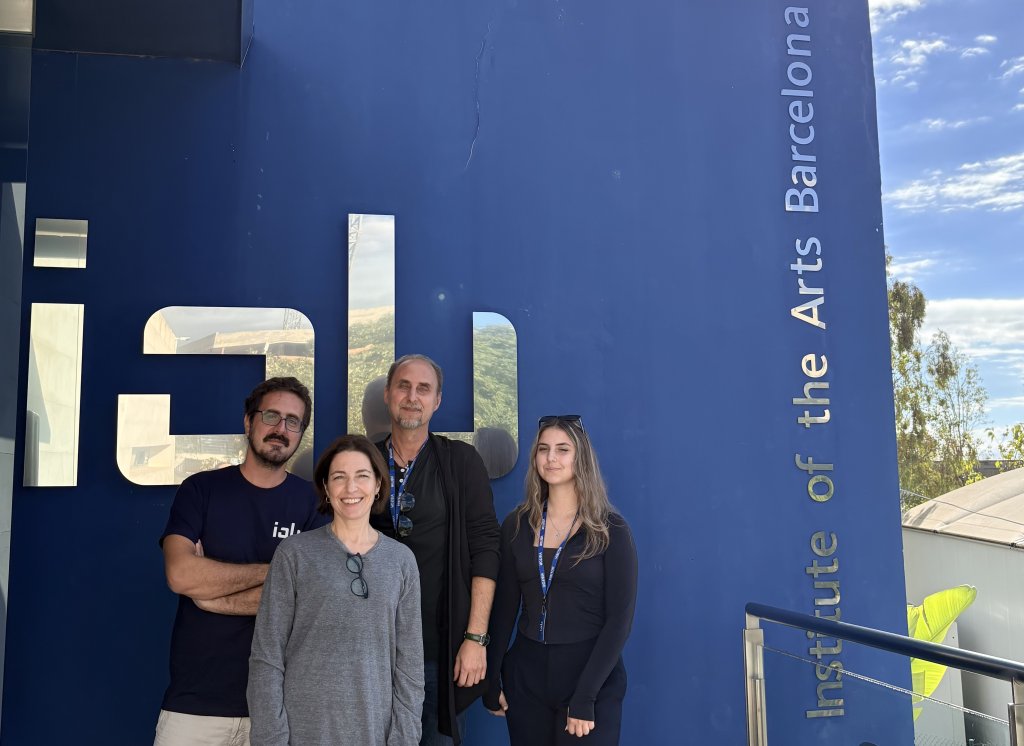
At institutions such as the Institute of the Arts Barcelona, critical thinking is often integrated into practical training, encouraging performers, directors, and writers to reflect on their work within a broader cultural and social context. As Călin Ciobotari suggests, criticism is not separate from theatre – it extends it. The ability to observe, interpret, and respond becomes a creative act in itself.
This perspective is particularly relevant in a moment where theatre is expanding beyond traditional forms, incorporating movement, technology, and interdisciplinary collaboration. In such an environment, the critic – whether professional or student – plays a vital role in documenting, questioning, and shaping the dialogue around performance.
Ultimately, developing a critical voice is not just for those who wish to become critics, but for anyone engaged in the arts. It fosters clarity of thought, artistic identity, and a stronger connection between creators and audiences.
More about Călin Ciobotari
- Academic profile: https://doctart.ro/en/phd-supervisors-theatre/calin-ciobotari/
- Publications: https://independent.academia.edu/CalinCiobotari
Adapted from a conversation with Performance Theory and Contextual Studies
Dr Valentina Temussi, PhD and FCActing Coordinator, and Prof. Armando Rotondi, PhD.